
Learning how to use AI to research your target customer can sound complicated when you are just starting an online business. You may think customer research requires expensive software, surveys, or years of marketing experience. It does not. AI can help you explore customer problems, goals, questions, and concerns in a simple way.
There is one important thing to remember from the beginning. AI can help you generate research questions, organize information, and discover possibilities, but you should not automatically treat everything AI tells you as a verified fact. Think of AI as a research assistant that helps you know what to investigate next.
Why Target Customer Research Matters Before You Create a Digital Product
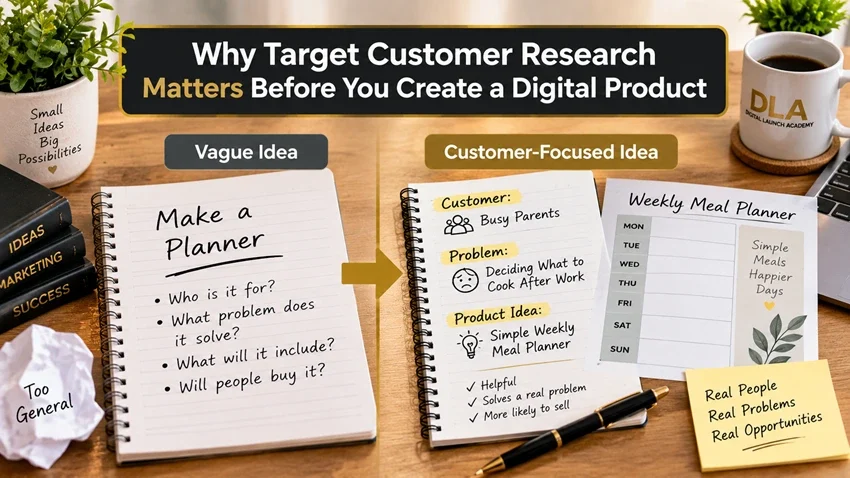
A useful digital product starts with a problem that a specific group of people wants help solving.
It is easy for a beginner to start with the product instead of the customer. You may decide, “I want to make a planner,” and immediately open Canva and start designing.
But who needs the planner? What are they trying to accomplish? Why would they choose your planner instead of another one?
Customer research helps answer questions like these.
Good research can help you understand who may need your product, what problems they are trying to solve, what they have already tried, and what result they want.
This can also help you develop better digital product ideas because you are starting with a customer’s needs instead of simply guessing what someone might buy.
For example, compare these two ideas:
“I want to make a planner.”
“I want to make a simple weekly meal planner for busy parents who struggle to decide what to cook after work.”
The second idea gives you much more information. You have a possible customer, a problem, and a desired result. It also gives AI useful context for helping you research the idea further.
You do not need to create a complicated customer avatar at this point. Start by identifying one type of person you believe you could help.
Your Action: Write one sentence describing the type of person you believe your digital product could help.
Once you have a starting customer in mind, you can use AI to explore that person’s situation more deeply.
How to Use AI to Research Your Target Customer

The basic process does not require complicated prompts.
One of the most useful things you can do is give AI clear context. Tell it who you think your customer is, what type of product or business you are considering, what problem you believe the customer has, and what you want to learn.
This is one practical way of using AI to build an online business without expecting AI to build the business for you.
Suppose you are considering a weekly meal planner for busy adults.
You could start with a simple prompt like this:
“I’m thinking about creating a simple weekly meal planner for busy adults. What are five common problems these people might have with planning meals each week?”
You do not need a long or technical prompt.
Read the response first. Then ask follow-up questions.
You might ask:
“What goals might these people have?”
“What frustrates them about their current meal-planning process?”
“What might prevent them from using a weekly meal planner?”
“What questions might they ask before buying one?”
Each question helps you look at the customer from a slightly different angle.
But remember that AI is suggesting possibilities. Its answer does not prove that every busy adult has those problems or would buy your planner.
At this stage, you are looking for ideas worth investigating.
Your Action: Give AI your one-sentence customer description and ask it to identify five problems that person might be trying to solve.
Now you have a starting list. The next step is to investigate the most useful possibilities more deeply.
Ask AI About Problems, Goals, Frustrations, and Questions
A large AI-generated customer report can quickly become overwhelming. Instead, research one area at a time.
Four useful areas to investigate are problems, goals, frustrations, and questions.
Problems
Ask what your potential customer is struggling to accomplish.
A problem should be specific enough that you can understand why the person wants help.
For example, “meal planning is difficult” is broad.
“Deciding what to cook after working all day takes too much time” gives you a clearer problem to investigate.
Goals
Next, look at what the customer wants to accomplish.
A person struggling with meal planning might want to save time, reduce food waste, spend less on groceries, or stop making last-minute dinner decisions.
These possible goals can help you understand what result your product may need to support.
Frustrations
Ask what makes the customer’s current situation difficult or discouraging.
Maybe existing planners are too complicated. Perhaps they require too much preparation or contain sections the customer never uses.
Frustrations can help you see why an existing solution may not be working for that person.
Questions
Finally, explore what the customer might want to know before moving forward.
Someone interested in creating printables, for example, may have questions about choosing an idea, learning design tools, setting prices, or finding customers.
AI can help you uncover these possible questions, but they are still research topics rather than confirmed facts.
That distinction matters.
Instead of asking AI to create a huge customer analysis all at once, ask about one area and study the answer. Then ask a follow-up question.
This makes the information easier to understand and helps prevent information overload.
Your Action: Choose one customer problem from your first AI response. Ask AI three follow-up questions about that one problem.
You now have more detailed possibilities. Before using them to make business decisions, you need to determine which ones are supported by real evidence.
Do Not Treat AI Customer Research as Proof
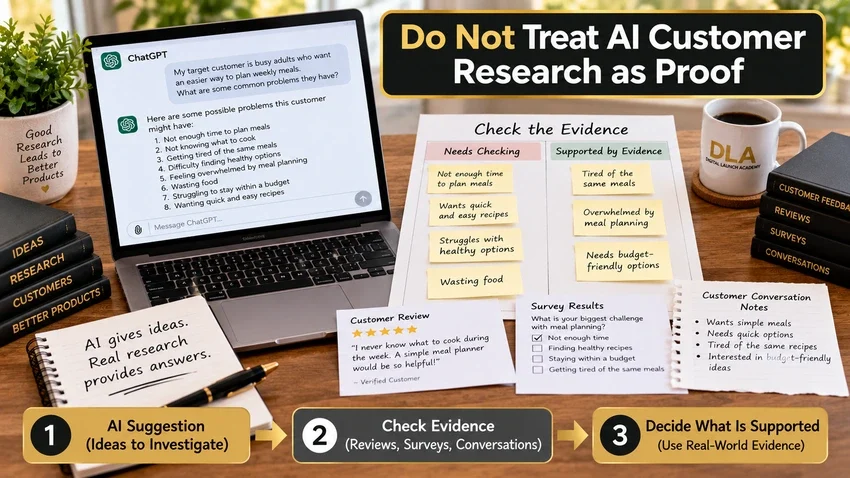
This is one of the most important parts of using AI for customer research.
AI can suggest possibilities. It can help develop research questions, summarize information you give it, organize your findings, and help you notice patterns.
What it cannot do by itself is prove that a particular group of people wants your product or will pay for it.
A simple rule to remember is:
AI gives you ideas about what to investigate. Real-world evidence helps you decide whether those ideas are accurate.
Suppose AI tells you that people over 50 who want to start an online business are mainly worried about learning technology.
That could be a useful idea to investigate. But you should not assume it is true for your entire audience simply because AI produced the answer.
Look for evidence.
That might include conversations with potential customers, frequently asked questions, customer reviews, search behavior, comments, online communities, surveys, or other firsthand and observable information.
You may discover that AI identified a real problem. You may also discover that the customer’s biggest concern is something completely different.
This verification process can also help you validate a digital product idea before spending too much time creating it.
The goal is not to prove AI right. The goal is to understand the customer more accurately.
Your Action: Look at the important claims AI generated about your customer. Mark each one either “needs checking” or “supported by evidence I found.”
Once you separate assumptions from evidence, you can organize what you have learned into a simple customer profile.
Create a Simple Target Customer Profile With AI

You do not need a complicated marketing document with dozens of details about an imaginary customer.
Create a simple working profile instead.
Include:
- Who the customer is
- Their main problem
- Their main goal
- Important frustrations
- Common questions
- Barriers preventing progress
- Information that still needs verification
AI can help organize this information.
For example, imagine your research points toward an adult over 50 who wants additional income, has limited technical confidence, wants to create a first digital product, and needs straightforward instructions.
You could give AI the research you collected and ask:
“Organize this information into a simple one-page target customer profile. Separate information supported by my research from information that still needs verification.”
This is where simple AI tools for beginners can be useful. You are not asking AI to decide who your customer is. You are asking it to help organize the information you collected.
Review the finished profile carefully.
If something does not match your research, remove it. If you do not know whether something is accurate, mark it for further research.
Your customer profile is not permanent. It should change as you talk to customers, receive feedback, make sales, and learn more about the people you serve.
Your Action: Ask AI to organize the information you have gathered into a one-page customer profile. Review every item and remove anything you cannot support or that does not fit your research.
Now you can use that research to make an actual product decision.
Use Your Customer Research to Make Better Digital Product Decisions
Customer research becomes valuable when it changes what you do.
What you learn can influence the problem your product solves, the format you choose, how complicated the instructions should be, the language you use, the features you include, and eventually how you explain the product in your marketing.
You do not need to solve every problem AI identifies.
Choose one clear customer, one meaningful problem, and one manageable solution.
Suppose your research shows that busy adults are frustrated because meal-planning systems feel too complicated.
You could create a large 50-page meal-planning bundle with trackers, calendars, worksheets, and recipe pages.
But that may add to the exact problem your customer already has: too much complexity.
A simple one-page weekly meal planner might be more useful.
Customer research helped shape that decision.
The same principle applies when you create your first digital product. More pages, features, and options do not automatically make a product more useful.
Start with the problem.
Then build the simplest useful solution you can.
Your Action: Finish this sentence:
My customer needs help with ______, so my product could help them ______.
You now have a basic customer-research process you can repeat as your business and your understanding of your audience grow.
Frequently Asked Questions
Can AI really help with target customer research?
Yes. AI can help you brainstorm research questions, explore possible customer problems and goals, organize information you collect, and analyze research you provide.
However, important assumptions should still be checked against reliable real-world evidence. AI is most useful as a research assistant rather than the final authority on what your customers think or want.
What information should I ask AI about my target customer?
Start with the basics.
Ask about possible problems, goals, frustrations, questions, barriers, and desired outcomes.
Research one area at a time. This makes the information easier to understand and gives you a chance to ask better follow-up questions.
Do I need expensive customer research tools?
No. A beginner can start simply.
AI, customer conversations, reviews, questions, comments, search behavior, and other accessible sources can give you useful places to begin.
More advanced tools may become useful later, but you do not need an expensive research system before learning about the people you want to help.
How do I know whether AI’s customer research is accurate?
Do not judge accuracy by how confident or detailed an AI answer sounds.
Look for real-world evidence supporting important claims.
If AI identifies a possible customer problem, investigate whether actual customers discuss that problem in conversations, questions, reviews, searches, surveys, comments, or other relevant sources.
If you cannot verify something, treat it as an idea that still needs checking.
Should I research my customer before creating my digital product?
Early customer research can reduce some of the guesswork involved in product creation.
You may learn which problem deserves attention, what type of solution people want, or what makes existing solutions frustrating.
You do not need perfect research before creating anything. Customer research should continue as you receive real feedback and learn more about your audience.
Use AI as a Starting Point, Not the Final Answer
Customer research does not need to become another complicated part of starting an online business.
Keep the process simple:
Start with a customer → use AI to explore → ask deeper questions → verify assumptions → organize findings → apply what you learn.
You do not need a perfect customer profile before moving forward.
You need enough understanding of a real group of people and a real problem to make your next decision with better information.
As you gain customers and receive feedback, keep updating what you know. Your first customer profile is a starting point, not something you have to get perfect.
Your Action: Spend 15–20 minutes completing one simple AI customer-research session and save the resulting customer profile for future product planning.

Don’t Know What to Create?
Most beginners don’t fail because they lack talent.
They fail because they’re overwhelmed by too many ideas.
Download the Free Niche Planner Checklist and discover a digital product idea you can actually build.
