
You can learn how to turn a problem into a digital product by starting with something familiar: a task that feels confusing, frustrating, or harder than it needs to be.
You do not need a completely new invention. You need a clear picture of who needs help and what would make one task easier.
An everyday problem might lead to a useful checklist, template, tracker, or short guide.
This article will walk you through choosing one problem and shaping it into a clear product idea. We will use a made-up example: a beginner gardener who forgets which plants were watered.
By the end, you will have one idea to investigate. You will still need to check whether other people want that solution before spending time creating it.
How Can You Turn a Problem Into a Digital Product?
Start by looking at what someone struggles to do. Then consider whether a simple resource could help.
A digital product is a file or resource someone can use electronically or download. It might help them remember steps, organize information, or understand a process.
For example, imagine a beginner gardener with several pots of herbs. They water some pots but later forget which ones they checked.
A watering tracker could give them one place to record what they did.
The connection is simple:
- Problem: Watering details are easy to forget.
- Helpful result: A clear record of which plants were watered.
- Possible product: A printable watering tracker.
Start with the task. Choosing software or designing pages comes later.
You can begin noticing possible ideas by paying attention to small difficulties in your own routine.
Your Action: Write one task you wish were easier to remember, organize, or complete.
Where Can You Find Everyday Problems Worth Exploring?
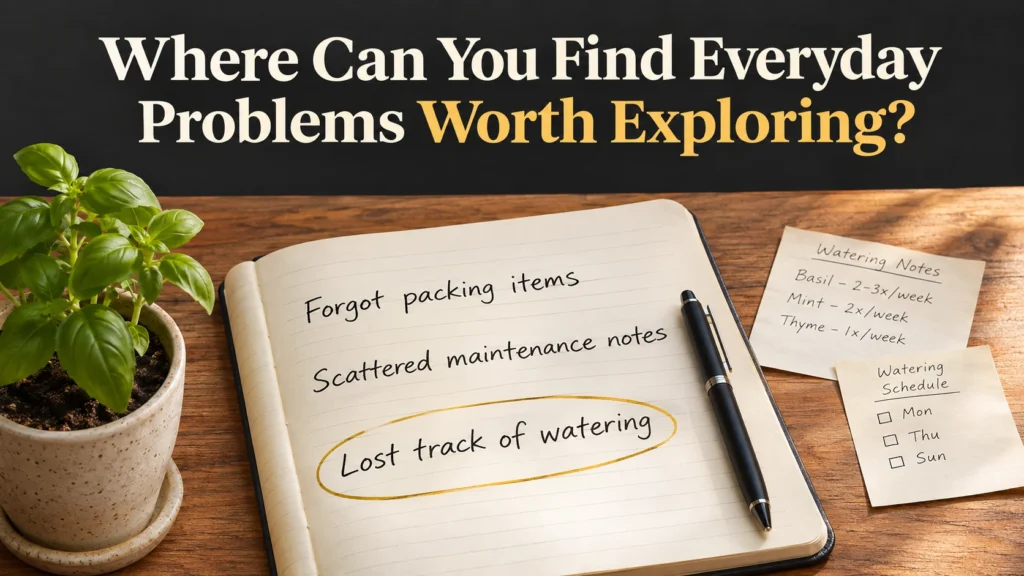
Everyday problems to solve with digital products can appear in activities you already understand. Look at your home routines, work experience, or hobbies.
Notice Tasks You Repeat or Put Off
Think about tasks that require you to gather the same information repeatedly.
Perhaps you rewrite a packing list before every trip. Maybe your household maintenance notes are scattered across several places.
Also notice tasks you delay because the steps feel unclear.
These situations might suggest checklist product ideas or simple templates. However, a personal frustration is only a starting point. Other people may handle the task differently.
Listen for Questions People Keep Asking
Pay attention when people ask:
- “How do I keep track of this?”
- “What am I supposed to do next?”
- “Is there an easier way to organize this?”
In our example, the gardener might say, “I cannot remember which pots I watered yesterday.”
That is more specific than “Gardening is difficult.” A specific problem is easier to explore.
Once you have a few possibilities, choose one you understand well enough to explain.
Your Action: List three everyday frustrations and circle one you understand well.
Who Needs Help With This Specific Problem?

A useful product idea connects a problem with a particular person. “Anyone who needs help” is too broad to guide your decisions.
Choose One Type of Person
Consider who experiences the problem you selected.
A person caring for three indoor plants may need something different from someone managing a large vegetable garden.
For our example, we will focus on a beginner growing herbs in pots on a patio.
This helps you choose a digital product niche—a specific area and group of people you want to serve. You do not need a complicated audience profile to begin.
Describe the Situation Clearly
Explain when the difficulty happens and what makes it frustrating.
Our gardener checks several pots at different times. Later, they cannot remember what they watered.
As you research your target customer, check whether this description matches their experience. Avoid assuming everyone has the same habits as you.
Knowing the person and situation will help you decide what improvement your product should support.
Your Action: Complete: “I want to help _____ who struggle with _____.”
What Small Result Could Your Product Help Someone Achieve?
Before choosing a format, decide what the resource should help someone do.
Describe One Useful Improvement
A useful result does not need to be dramatic.
It might mean having information in one place, remembering a set of steps, or spending less time recreating a routine.
For the gardener, the result is having a record of watering that is easy to check.
That is something a tracker can support. It cannot guarantee healthy plants or decide when every plant needs water.
Keep your promise connected to what your resource actually provides.
Keep the First Idea Manageable
It is easy to add more features once you start thinking.
You might consider including fertilizer records, planting calendars, pest information, and a complete gardening guide.
Those additions could turn a small idea into a much larger project.
For now, focus on the original problem: keeping track of watering.
A clear result makes the next decision easier. You can choose a format that helps deliver that result.
Your Action: Write: “This resource will help the reader _____.”
Which Digital Product Format Fits the Problem?

Choose a format based on how someone will use the resource. The number of pages matters less than whether those pages help them complete the task.
Checklists for Remembering Steps
A checklist helps someone remember actions or items.
For example, a packing checklist could help a traveler check what is ready before leaving home.
This format fits problems involving forgotten steps. Each item should be easy to understand and check off.
Templates and Trackers for Organizing Information
A template provides a structure someone can fill in. A tracker helps them record activities or changes over time.
These formats suit problems involving scattered notes or information that is difficult to remember.
Our watering tracker might include spaces for the date, plant name, and watering notes. Its job is to make recording and reviewing information straightforward.
Short Guides for Explaining a Process
A short guide explains how to complete a task.
Digital guide ideas for beginners might come from a process you understand well and can teach clearly.
If the problem is “I do not know how to do this,” a guide may fit better than a blank tracker.
Once you are ready to create your first printable, a tool such as Canva can be considered. You do not need to begin designing while you are still choosing the idea.
Your Action: Choose one format and write why it fits your problem.
How Do You Turn These Decisions Into One Clear Product Idea?

You now have the pieces needed to explain your idea.
Write a One-Sentence Product Idea
Use this simple pattern:
“A [format] for [person] who struggles with [problem], helping them [useful result].”
Our example becomes:
“A printable watering tracker for beginner patio gardeners who lose track of watering, helping them keep their notes in one place.”
This sentence explains the product without needing a name, logo, or sales page.
It also gives you something clear to discuss when investigating the idea.
Check That the Idea Stays Focused
Read your sentence and ask:
- Can I tell who it is for?
- Does it address one clear problem?
- Does the format fit the task?
- Is the result realistic?
If your sentence needs a long list of features, return to the main problem.
You can consider extra ideas later. Your next step is to investigate whether this focused idea would help the intended reader.
Your Action: Write your product idea using the sentence pattern.
What Should You Check Before You Start Creating?
A clear idea is useful, but it is not proof that people will buy.
Before building, validate your digital product idea by learning more about the people you hope to help.
Find out whether they experience the problem, what they currently do, and what is difficult about their approach.
For our example, you could ask a patio gardener:
“How do you currently keep track of watering, and what is difficult about that method?”
This invites them to describe their experience. It can reveal more than asking whether they like your tracker idea.
They might already have a method that works. They might struggle with a different problem.
Listen before deciding what their answer means. Friendly encouragement alone does not show willingness to pay.
You can decide how to price your first digital product later, after investigating its usefulness and demand.
Your Action: Write one question you could ask someone who experiences your chosen problem.
Common Questions About Turning Problems Into Product Ideas
Does My Digital Product Idea Have to Be Completely New?
No. Your idea can address a familiar problem.
Focus on making the resource useful for a specific person and situation. You still need to investigate demand and create your own work.
You do not need to invent an entirely new product category to begin exploring an idea.
What if Someone Already Sells a Similar Product?
Study what it helps people do and who it serves. A similar product gives you something to investigate, but its existence does not prove that your version will sell.
Look for a meaningful reason your intended audience might find your approach useful. Do not copy another creator’s wording or design.
Do I Need Design Skills Before Choosing an Idea?
No. You can describe the person, problem, and useful result in a notebook.
Design becomes relevant when you are ready to create the resource. At this stage, focus on understanding the task and choosing a suitable format.
Can AI Help Me Think Through My Product Idea?
Yes. AI can help you organize your notes or make a problem statement clearer.
For example, you could ask it to help explain the gardener’s difficulty using your own observations.
Review its suggestions carefully. An AI suggestion does not establish that real customers experience the problem or want to pay for a solution.
These questions do not all need to be settled today. Start with the concern most likely to stop your progress.
Your Action: Choose your biggest concern and write one small step to investigate it.
Your Next Step: Keep One Clear Product Idea
An everyday frustration can give you a practical starting point.
You have worked through who needs help, what they struggle with, what result would be useful, and which format might fit.
Our example began with forgotten watering details. It became an idea for a simple tracker with one clear purpose.
Your idea may be a checklist, template, tracker, or short guide. What matters now is that you can explain how it might help someone.
You do not need to build it immediately. Keep your idea focused and investigate it before investing heavily in creation.
Your Action: Save your one-sentence product idea and the question you will use to investigate it.
Don’t Know What to Create?

Most beginners don’t fail because they lack talent.
They fail because they’re overwhelmed by too many ideas.
Download the Free Niche Planner Checklist and discover a digital product idea you can actually build.
