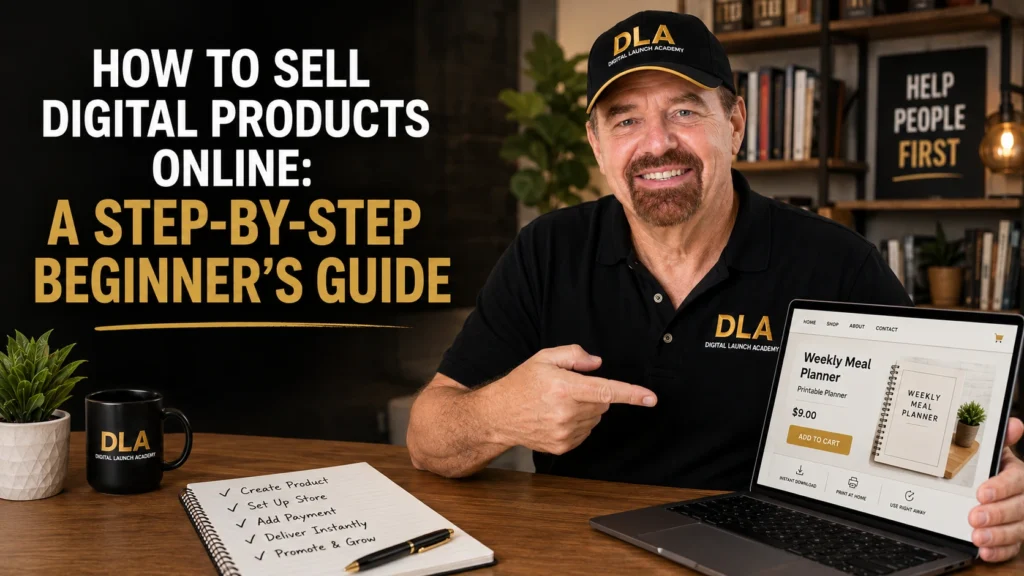
Learning how to sell digital products can feel complicated when you are starting from scratch. You may have questions about what to sell, where to sell it, how much to charge, how customers will pay, and how you will find people who might actually buy it.
The good news is that you do not have to solve all of those problems at once.
Selling digital products is a process. When you break that process into individual steps, it becomes much easier to understand.
You start with a useful product. You identify who it can help. You create a clear offer, choose where to sell it, set a price, and give customers a simple way to buy and receive it. Then you begin promoting it, learning from your results, and improving what you already have.
This guide will walk you through that process one step at a time.
How to Sell Digital Products: Understand the Process First
A digital product is something a customer can purchase and receive electronically. It might be a printable planner, checklist, template, ebook, workbook, online course, or another useful digital resource.
Unlike a physical product, you do not have to package the item in a box and ship it to the customer.
The basic process looks like this:
Product → Offer → Sales Page or Storefront → Customer → Payment → Digital Delivery
Imagine you created a weekly meal planner.
A potential customer discovers your meal planner through a blog post, video, search result, or another source. They visit the page where you explain what the planner does. If they decide it will help them, they purchase it.
Their payment is processed, and they receive access to the digital file.
That is the basic transaction.
There can eventually be more pieces around it—email marketing, additional products, automation, content marketing, and other business systems—but you do not need all of that to understand how selling digital products works.
Start with the basic process.
Your Action
Write down the digital product you want to sell and the one main problem it solves.
Once you understand what your product is supposed to accomplish, you can make sure it has a clear purpose.
Step 1 – Make Sure Your Digital Product Solves One Clear Problem

One of the easiest ways to make a first digital product unnecessarily difficult is to try to make it solve too many problems.
Your first product does not have to be huge.
It needs to be useful.
For example, imagine creating a general “life planner.” That could include finances, meals, exercise, appointments, goals, household chores, and dozens of other areas.
Suddenly, a simple product has become a large project.
Instead, you could create a weekly meal planner that helps busy adults organize meals and grocery shopping.
That product has a clear purpose.
When someone sees it, they can quickly understand what it is and why they might want it.
This clarity also makes the product easier to sell because you can explain its value without a long explanation.
A focused checklist, planner, template, workbook, or guide can provide meaningful value without containing dozens of pages.
Do not measure the quality of your product by its size.
Measure it by how well it helps the customer accomplish the job it was designed to do.
Your Action
Complete this sentence:
My product helps _ do _.
If you can complete that sentence clearly, you have taken an important first step.
Next, you need to identify the person who is most likely to need that help.
Step 2 – Know Who You Are Selling To
Trying to sell a product to everyone usually makes marketing harder.
You do not need to create an elaborate customer profile before making progress. You simply need enough clarity to understand who has the problem your product solves.
Ask yourself:
Who has this problem?
What are they trying to accomplish?
How would they describe the problem in their own words?
Why would my product be useful to them?
Suppose you created the weekly meal planner from our earlier example.
You might decide it is designed for busy parents who are tired of deciding what to make for dinner every evening.
That is much clearer than saying your product is “for anyone who eats meals.”
Knowing the customer also helps you make better decisions about your product.
You can choose instructions, examples, wording, and features based on what that particular customer actually needs.
You do not need to know everything about your customer. You simply need a clear starting point.
Your Action
Write one sentence describing the person most likely to need your product.
Now you know what you are selling and who you are trying to help. The next step is turning that product into an offer people can understand.
Step 3 – Turn Your Product Into a Clear Offer

Having a digital product and having a clear offer are not exactly the same thing.
The product is what you created.
The offer explains why someone should care about it.
A simple offer should answer a few basic questions:
What does the customer receive?
What problem does it help solve?
What useful benefit does it provide?
Why would that benefit matter to the customer?
What should the customer do if they want it?
For example, “20-page printable PDF” describes a product.
But that description alone does not explain why someone would want it.
A clearer explanation might tell the customer that the printable provides a simple weekly system for planning meals and organizing a grocery list in one place.
Now the customer understands the practical purpose.
You do not need a complicated collection of bonuses or exaggerated promises to create a good offer. In fact, those things can make a beginner offer harder to understand.
Clarity is more important.
Your Action
Write three simple statements:
What does the buyer receive?
What does it help them do?
Why does that matter to them?
Once your offer is clear, you need somewhere customers can purchase it.
Step 4 – Choose Where to Sell Your Digital Product

There is no single place where every beginner must sell digital products.
You have several basic choices.
A marketplace allows you to list products on an existing platform. The platform provides much of the selling infrastructure, but there may be fees, rules, and limitations.
Your own website gives you more control over your business and customer experience, but you are responsible for setting up and managing more of the process.
A hosted storefront can provide another option by giving you tools for selling products without requiring you to build an entire e-commerce system yourself.
Each approach has advantages and disadvantages.
For a beginner, the important question is not:
Which selling platform is perfect?
A better question is:
Which reasonable option can I learn and use consistently?
Consider ease of setup, cost, fees, control, and how comfortable you feel managing the system.
You can change or expand your selling setup later. Your first decision does not have to determine how you operate your business forever.
Your Action
Choose one place where you will start selling your digital product.
Do not set up three different storefronts yet. Pick one starting point.
Then you can turn your attention to pricing.
Step 5 – Price Your Digital Product
Pricing can stop beginners in their tracks because they assume there must be one perfect price.
There usually isn’t.
Your starting price is a business decision that you can evaluate and adjust as you learn.
Think about the usefulness of the product, what the customer receives, the problem it helps solve, and the overall scope of the product.
You can also look at comparable products to better understand the market. The goal is not to copy another seller’s price. It is to give yourself context.
One mistake is pricing a digital product entirely according to how long it took you to create.
The customer does not know that you spent three hours or three weeks making it.
They are primarily concerned with whether the product is useful to them and whether the value makes sense compared with the price.
You also do not need to spend weeks worrying about a small difference in your starting price.
Choose a reasonable price, put the product in front of real customers, and learn.
Your Action
Choose a starting price that you are comfortable testing.
Now you need a simple page or listing that explains what customers will receive for that price.
Step 6 – Create a Simple Sales Page or Product Listing
You do not need to become an expert copywriter before you can create a basic sales page.
Your goal is clarity.
A potential customer should be able to look at the page and understand what the product is, why it could help them, what they receive, and what they need to do next.
Write a Clear Headline
Your headline should help the visitor understand the product quickly.
Avoid clever wording that forces the customer to figure out what you are selling.
A clear headline is usually more useful than a creative but confusing one.
Explain the Problem and Benefit
Describe the problem the product addresses and the useful outcome it is designed to provide.
Keep your promises realistic.
You do not need to claim that your product will “change someone’s life” when it simply helps them organize their weekly meals.
Solving a small, frustrating problem can still be valuable.
Show What the Customer Receives
Tell customers exactly what is included.
If they receive a PDF, say so.
If the product includes five templates, explain that.
If it contains lessons, worksheets, checklists, or other materials, make those clear.
A customer should not have to guess what they are buying.
Make the Purchase Step Clear
When someone decides they want the product, the next step should be obvious.
Do not make customers search the page trying to determine how to purchase.
Clarity matters more than sophisticated design or clever sales language.
Your Action
Draft these four pieces of your sales page:
One headline.
Three main benefits.
What the customer receives.
The purchase instruction.
With the product presentation in place, you can focus on what happens when someone actually buys.
Step 7 – Set Up Payment and Digital Delivery

A customer should have a simple path from deciding to buy your product to receiving it.
There are several parts to this process.
The checkout is where the customer enters the information required to purchase.
Payment processing is the system that handles the financial transaction.
Digital delivery is how the customer receives the file, download, course access, or other digital material they purchased.
You do not have to understand every technical detail behind these systems.
You do need to understand the customer’s experience.
This is why testing is important.
Go through the process yourself before sending customers to the product.
Check what happens after checkout.
Does the customer receive the correct product?
Are the instructions understandable?
Does the download work?
If account access is required, is it clear how the customer gets in?
If you need instructions for a specific payment processor or selling platform, use that company’s current official documentation rather than relying on an old tutorial. Platforms and settings can change.
Your Action
Test the complete customer process, from checkout through successful product delivery.
Once you know the purchase system works, you are ready to start helping potential customers discover the product.
Step 8 – Promote Your Digital Product Without Trying to Be Everywhere
Creating a product does not automatically bring customers to it.
People need a way to discover that your product exists.
This is where marketing comes in.
But there is a common beginner mistake: trying to market everywhere at once.
You start a blog.
Then you decide you need YouTube.
Then Pinterest.
Then email.
Then several social media accounts.
Before long, you are spending all of your time learning platforms instead of consistently using any one of them.
Start with one primary traffic source.
Choose a method you are willing to learn and use consistently.
Then create useful content around the problems your potential customers already have.
For example, someone selling a meal planner could create content about weekly meal planning, grocery organization, reducing food waste, or simplifying dinner decisions.
That content helps the right people discover you.
When your product genuinely helps with the problem being discussed, mentioning it becomes a natural extension of the teaching rather than an interruption.
You can expand into additional marketing channels later.
Your Action
Choose one primary traffic source to focus on first.
Consistency with one method gives you something you can evaluate. That becomes especially important as you work toward your first sales.
Step 9 – Work Toward Your First Digital Product Sales
Your first sales matter for more than the money they generate.
They give you information.
Until real people interact with your product and sales process, many of your decisions are educated guesses.
Pay attention to what happens.
What questions do potential customers ask?
What parts of your offer seem confusing?
Are people finding the sales page?
Do customers understand what they receive?
Does anyone have trouble accessing the product after purchasing?
These small pieces of information can help you identify where the selling process needs work.
Keep your expectations realistic.
Publishing a product does not guarantee immediate sales. Building traffic and earning customer trust can take time.
Instead of measuring your new business against established sellers, concentrate on the actions you can control.
Your Action
Set one realistic first-sales goal and identify one marketing activity you will perform consistently.
As you gather information from real customers and potential customers, you can start improving the business based on evidence.
Step 10 – Improve Before You Create Something New
When a product does not sell as quickly as expected, a beginner may assume the solution is to abandon it and create something completely different.
Sometimes a product does need significant changes.
But creating another product should not automatically be your first response.
Look at the existing process.
Are customers confused about what the product does?
Is the sales page clear?
Are the product instructions easy to follow?
Are enough of the right people actually seeing the offer?
Are customers asking the same question repeatedly?
Is your marketing attracting people who have the problem the product solves?
These questions help you identify where improvement may be needed.
Make changes based on evidence whenever possible rather than changing everything because you are discouraged by an early result.
A small improvement to the product description, instructions, offer, or marketing process may be more useful than starting over.
Your Action
Identify one part of your current product or selling process that you can improve before creating another product.
Once the basic process is working, you can begin thinking about growth without making the business unnecessarily complicated.
Grow Your Digital Product Business One Step at a Time
Growing a digital product business does not mean adding every possible strategy.
It means learning from what works and gradually building on it.
If one type of content consistently brings the right visitors to your website or storefront, create more useful content around that subject.
If customers repeatedly tell you that one feature of your product is particularly helpful, pay attention to that.
If you discover a recurring customer problem that your existing product does not solve, that information may eventually help you decide what product to create next.
You can also begin creating simple systems for tasks you perform repeatedly.
The goal is steady improvement.
You do not need ten products, five traffic sources, complicated automation, and a large audience before you have a real business.
Build the next piece when there is a reason to build it.
There are no guaranteed sales numbers or timelines. Different products, audiences, prices, and marketing methods produce different results.
What you can control is whether you continue learning, testing, improving, and taking useful actions.
Your Action
Choose the one part of your business that needs attention next.
Work on that before adding another strategy.
Frequently Asked Questions
How do beginners start selling digital products?
Start with one useful product that solves a clear problem. Identify who needs it, create a simple offer, choose one place to sell it, set a starting price, create a clear sales page or listing, and make sure payment and digital delivery work correctly. Then choose one way to begin promoting it.
You do not need to build an entire online business at once.
What is the easiest digital product to sell?
There is no single digital product that is easiest for everyone to sell.
For a beginner, a simple product such as a checklist, planner, template, short guide, or workbook can be easier to create and manage than a large product.
The better question is whether the product solves a clear problem for a specific customer.
Where can I sell digital products?
Digital products can be sold through marketplaces, your own website, or hosted storefront platforms.
The right starting option depends on factors such as cost, fees, ease of setup, control, and your technical comfort level.
Beginners usually do not need multiple selling platforms at the beginning. Choose one reasonable option and learn how it works.
How much should I charge for my first digital product?
There is no universal price for a first digital product.
Consider the usefulness of the product, what the customer receives, the problem it addresses, its scope, and comparable products in the market.
Choose a reasonable starting price and be willing to evaluate it as you receive real customer feedback.
Do I need a website to sell digital products?
Not necessarily.
Some marketplaces and hosted storefronts allow you to sell without building your own full website.
A website can provide additional control and become an important business asset over time, but it does not have to be the first requirement for every beginner.
How do customers receive digital products after purchasing?
That depends on the selling system you use.
A customer may receive a download link, an email containing access information, access to an online account, or another form of electronic delivery.
Whatever system you choose, test the complete process yourself so you know what your customer will experience.
How long does it take to make your first digital product sale?
There is no reliable timeline that applies to every digital product business.
Results depend on factors such as the product, audience, price, offer, traffic, marketing, and existing customer trust.
Instead of expecting a guaranteed timeline, focus on consistently getting your product in front of the right people and learning from the response.
Once your product is ready to sell, the next challenge is finding that first customer. Follow these steps to get your first digital product sale without trying to master every marketing strategy at once.
Conclusion
Learning how to sell digital products becomes much easier when you stop looking at it as one enormous project.
The process is:
Product → Customer → Offer → Selling Method → Price → Sales Page → Payment & Delivery → Promotion → First Sales → Improvement → Growth
You do not have to master every part today.
Make sure your product solves a clear problem. Know who it is for. Explain the offer clearly. Give customers a reliable way to purchase and receive it. Then start promoting it consistently and pay attention to what you learn.
As the business develops, improve what is already working before adding unnecessary complexity.
You do not need to know everything before you begin.
You need to know your next logical step.
Don’t Know What to Create?

Most beginners don’t fail because they lack talent.
They fail because they’re overwhelmed by too many ideas.
Download the Free Niche Planner Checklist and discover a digital product idea you can actually build.
