
Most beginners do not struggle because they cannot make a planner or checklist. They struggle because they make something for “everyone.” Learning how to find your customer helps you create a digital product that solves one clear problem for one clear person. You do not need marketing experience to do this. You just need to pay attention to the problems people already talk about.
Start With a Person, Not a Product
It is tempting to begin with, “What can I make in Canva?” But start with, “Who do I want to help?” This makes every later step easier, from choosing colors to writing a product description.
Your customer is the person most likely to buy and use your digital product. They may be a busy parent trying to organize meals, a new teacher preparing a classroom, or a retiree tracking a monthly budget.
You are not trying to choose the perfect customer forever. You are choosing a starting point. Your first digital product can be simple, and you can create products for other groups later.
Step 1: Choose a group you understand
Pick a group based on your own experience, work history, hobbies, or daily life. You do not have to be the world’s top expert. You only need to understand a problem well enough to make a useful tool.
For example, you might understand:
- Working parents who need quick meal plans
- Adults trying to pay down debt
- New dog owners who need a care routine
- Church volunteers planning events
- Gardeners who want to track planting dates
- People caring for aging parents
A good customer group is specific enough that you can picture them. “People who want to get organized” is too broad. “Busy moms who want to plan weekday dinners” is much clearer.
Simple action: Write down three groups of people you know or understand. Circle the one you would feel comfortable helping first.
Find a Problem People Want Solved
A customer buys a digital download because it makes something easier. Your planner, tracker, template, or guide does not need to change their whole life. It needs to help with one task that feels frustrating, confusing, or time-consuming.
When you research customer problems, look for repeated questions. If several people ask the same question, that is a useful clue. It may become a digital product idea.
Step 2: Look for everyday frustrations
Think about the group you chose. What do they put off? What takes too much time? What are they worried about getting wrong?
A busy parent may say, “I never know what to make for dinner.” A beginner gardener may ask, “When should I start my seeds?” A person trying to save money may think, “I keep losing track of where my paycheck goes.”
These are not just complaints. They are possible product ideas:
| Customer problem | Simple digital product idea | | — | — | | “Dinner planning stresses me out.” | Weekly meal planner with grocery list | | “I forget my bills.” | Monthly bill payment tracker | | “I do not know what to pack for a trip.” | Printable travel packing checklist | | “My dog’s care schedule is all over the place.” | Pet care and vet visit tracker |
Keep the problem small. A meal planner is easier to create and sell than a huge guide called “Fix Your Entire Family Life.” Small products are less overwhelming for you and more useful for a buyer who wants help now.
Simple action: Finish this sentence: “I want to help [group] who struggle with [one problem].”
Where to Research Your Target Customer
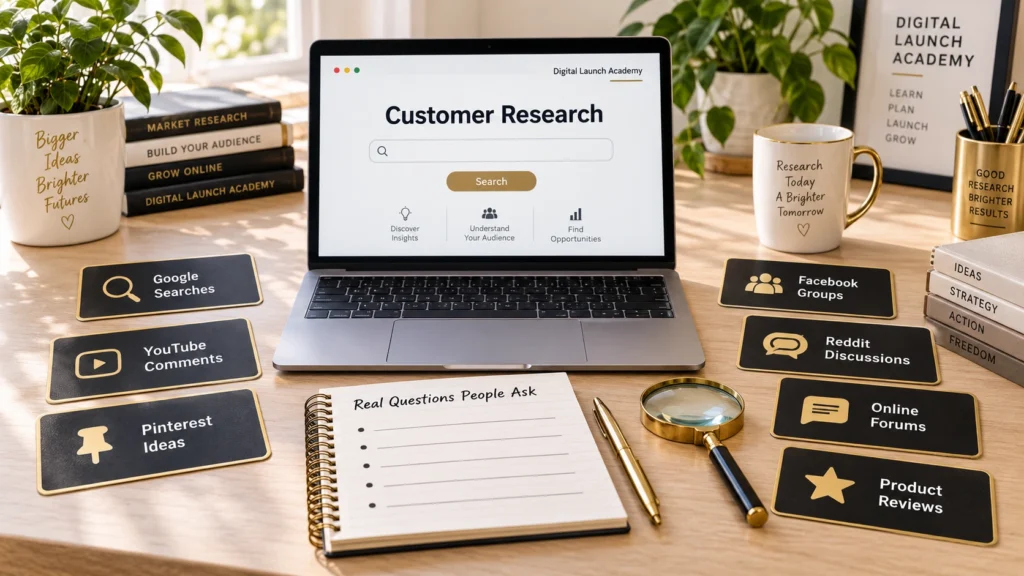
You do not need expensive software or a pile of data to find your target audience. Start with places where people ask questions in plain language. You are looking for their real words, not fancy business terms.
Step 3: Search where conversations already happen
Use Google, YouTube, Pinterest, Facebook groups, Reddit, online forums, and product marketplaces. Type in a simple phrase related to the problem you chose.
For example, if you want to help busy parents with meals, search phrases such as “easy meal planning for busy moms,” “weekly meal plan ideas,” or “how to make a grocery list for the week.” Notice the suggested searches that appear as you type. These suggestions often show what people are already looking for.
Then read comments, questions, and reviews. You are not copying someone else’s product. You are learning what buyers wish were easier.
Write down exact phrases you see, such as:
- “I need something simple.”
- “I never have time to set this up.”
- “I wish this had a spot for…”
- “This is confusing for beginners.”
Those words can later help you name your product and write your listing. More importantly, they tell you what matters to your customer.
Simple action: Spend 20 minutes researching one problem. Save or write down five real questions people ask.
Check Whether Your Idea Is Clear Enough
A good digital product idea should pass a simple test. Can you explain who it is for, what it helps them do, and what they receive in one sentence?
For example: “This printable weekly meal planner helps busy parents choose dinners and make a grocery list in less time.”
That is much stronger than: “This is a beautiful life organizer.” The second sentence sounds nice, but it does not tell a buyer why they need it.
Step 4: Use the one-sentence customer test
Fill in this sentence:
My [product type] helps [specific person] do [specific task] without [common frustration].
Here are a few examples:
- My budget tracker helps retirees organize monthly expenses without complicated spreadsheets.
- My classroom checklist helps new teachers prepare for the first week of school without forgetting important tasks.
- My dog care planner helps first-time dog owners track feeding, grooming, and vet visits without using several apps.
If your sentence feels fuzzy, narrow it down. You may be trying to solve too many problems at once. A product for “all pet owners” can become a simple puppy care tracker for first-time owners. That is easier to market because the buyer can quickly see themselves in it.
Simple action: Write your one-sentence customer test. Read it out loud. If it is easy to understand, you are on the right track.
Talk to Potential Buyers Before You Create Too Much

You do not need to build a large audience before you begin. A few honest conversations can teach you more than hours of guessing.
Think of people you already know who fit your customer group. You might ask a coworker, neighbor, family member, or friend. Keep it casual and do not pressure anyone to buy.
Step 5: Ask simple customer research questions
Ask what they currently do to handle the problem. Then ask what feels difficult about it. Listen more than you explain.
You can say, “I am thinking about making a simple printable meal planner for busy parents. How do you plan dinners now?” Follow with, “What is the hardest part?”
Avoid asking only, “Would you buy this?” People often want to be kind, so the answer may not be useful. Instead, ask about what they already use, what they have tried, and what they wish they had. Their answers will help you make a better product.
If nobody you know fits your audience, use online comments and reviews as your starting research. You can still create a first version, then improve it as you learn.
Simple action: Ask one person two questions about the problem you want to solve. Write down their exact answer.
Make a First Product for One Clear Need
Once you know your customer and their problem, do not get stuck researching forever. Create a small first product. A single-page checklist, a five-page planner, or a simple Canva template is enough to begin.
Your goal is not to make the biggest product. Your goal is to make a useful product that feels easy for a beginner to use.
Step 6: Build the helpful parts first
Before worrying about fancy design, list what your customer needs to complete the task. A weekly meal planner might need space for meals, a grocery list, and notes. A bill tracker might need bill names, due dates, amounts, and a paid checkbox.
Open Canva and choose a clean page layout. Use large, readable text. Leave plenty of blank space for writing. Pick two or three colors at most. Your customer wants a tool that works, not a page that feels crowded.
When your product is finished, look at it through your customer’s eyes. Would they know what to do without extra instructions? Would it save time or reduce stress? If yes, you have made something valuable.
Simple action: Create the first page of your product today. Do not wait until you feel fully ready.
Your Customer Will Become Clearer as You Go

Finding your ideal customer is not a one-time decision. Your first product gives you a place to start, not a box you are trapped in. As you get feedback, you may learn that buyers want a different page, a simpler version, or a related product.
That is normal. It means you are listening.
Start with one person, one problem, and one simple digital product. You do not need to be an expert in technology or sales to take that first step. You only need to help someone make one part of life a little easier.
Frequently Asked Questions About How to Find Your Customer
What is a target customer for a digital product?
Your target customer is the specific type of person most likely to need and use your digital product. For example, a weekly meal planner might be created for busy parents who struggle to plan weekday dinners.
How do I find my customer for digital products?
Start with a group of people you understand. Research their questions, frustrations, and everyday problems. Look at Google searches, YouTube comments, Facebook groups, Reddit discussions, product reviews, and online marketplaces to learn what they need.
Do I need marketing experience to find my customer?
No. You only need to listen carefully and notice problems people repeatedly discuss. Write down the words they use because those words can help you create, name, and describe your product.
Can my digital product be for everyone?
A product made for everyone usually feels too general. Choose one type of person with one clear problem. You can always create different products for other customer groups later.
How can I tell whether I have chosen the right customer?
You should be able to explain your customer and their problem in one simple sentence. Try this: “I want to help [specific group] who struggle with [one problem].” If the sentence is easy to understand, you have a useful starting point.
Should I talk to potential customers before creating my product?
Yes. Ask a few people how they currently handle the problem, what feels difficult, and what they wish were easier. Their answers can help you create a simpler and more useful digital product.
What if my target customer changes later?
That is normal. Your first customer gives you a place to begin. As you receive feedback and make sales, you may discover a more specific customer group or a related problem that needs a new product.
Don’t Know What to Create?

Most beginners don’t fail because they lack talent.
They fail because they’re overwhelmed by too many ideas.
Download the Free Niche Planner Checklist and discover a digital product idea you can actually build.
