
Digital product success stories can make starting an online business look much easier than it really is. You may see someone with hundreds of sales, a large email list, or a successful online store and wonder how you could ever reach that point.
What you usually do not see is everything that happened before the success.
You do not see the first idea that did not work, the product that needed to be redesigned, the confusing sales page, or the weeks spent learning a new tool. You also may not see the small wins that happened long before the business became successful.
For a complete beginner, success does not have to mean thousands of customers or a large monthly income.
Success might mean choosing your first product idea. It might mean finishing something you started. It could be publishing your first product, getting useful feedback, making your first sale, or learning enough from your first attempt to make the next one better.
Those are the kinds of lessons that can help you build a real business.
This guide is not about overnight success. It is about what beginners can learn from starting, making mistakes, improving, and continuing one step at a time.
What Digital Product Success Stories Can Really Teach Beginners
A success story can be useful, but it is important to understand what it can and cannot teach you.
One person’s results are not a guarantee of what will happen to you.
Two people can create similar products and get completely different results. They may have different audiences, experience levels, marketing methods, available time, or budgets. One person may already have an email list while another person is starting without an audience at all.
That is why the most useful question is usually not:
“How much money did they make?”
A better question is:
“What did they learn that I can apply to my own business?”
Suppose you read about someone who built a successful printable business. It would be easy to think, “I should create the same type of printable.”
But copying the product misses the most important lesson.
Instead, look at the process. How did that person identify a problem? What made the product useful? How did potential customers discover it? What did the creator change after receiving feedback?
Those lessons can be applied to many different types of digital products.
You can also look for patterns that appear repeatedly. Successful creators often learn to start with a clear problem, create something useful, finish what they start, listen to customers, and improve as they gain experience.
Most importantly, do not compare your starting point with someone else’s finished business.
You may be looking at the result of years of work while you are still learning how to create your first product.
Your Action: Write down one thing you want to learn from other beginners’ experiences.
Once you begin looking at success as a source of lessons instead of a promise of identical results, it becomes easier to recognize what success can look like at the beginning.
Beginner Success Often Starts With a Much Smaller Win

Your first success may be much smaller than you expect.
That does not make it unimportant.
When you are new to digital products, there are many steps between having an idea and building a business. Each completed step moves you forward.
An early win could be:
- Choosing one product idea.
- Validating an idea before spending weeks creating it.
- Learning enough Canva to make something useful.
- Completing your first product.
- Publishing the product online.
- Receiving helpful customer feedback.
- Getting your first website visitor or email subscriber.
- Making your first sale.
Beginners sometimes overlook these milestones because they are focused on the final goal of earning money.
Income matters in a business, but it is not the only sign that progress is happening.
Imagine someone who has spent three months watching tutorials about selling digital products. They have notebooks filled with ideas, but they have never finished anything.
Then they choose one simple checklist, create it, and publish it.
They may not have a steady stream of sales yet, but something important has changed.
They went from learning about creating digital products to actually creating one.
That experience gives them something another tutorial cannot: firsthand knowledge of the process.
Finishing one useful product can teach you more than starting five different products and completing none of them.
Your Action: Choose one small win that would represent progress for you right now.
Your first opportunity to achieve that win may be closer than you think. In fact, a useful product idea may already be hiding in your own experience.
Life Experience Can Become a Useful Digital Product
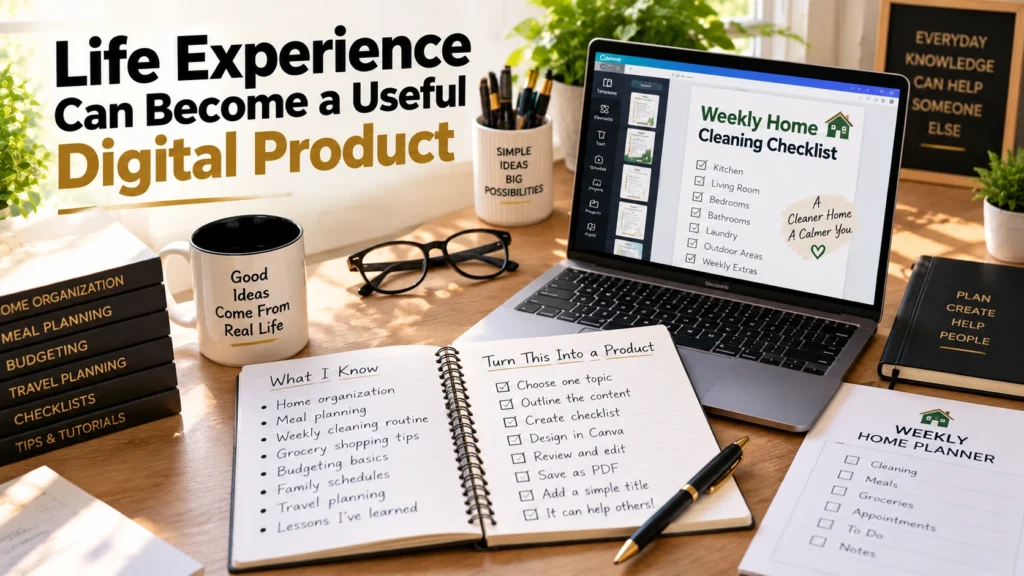
You do not need to be a technical expert to have useful knowledge.
Think about everything you have learned through your career, hobbies, family life, retirement, household responsibilities, personal projects, or problems you have already solved.
You probably know how to do things that someone else is still trying to figure out.
That knowledge can sometimes become the starting point for a digital product.
For example, perhaps you created a simple system for planning meals every week. Someone else may struggle with that exact problem.
Your system might become a meal planner, checklist, template, or short guide.
Maybe you spent years organizing projects at work. Some of the basic methods you learned could help a small-business owner who struggles to stay organized.
The goal is not to ask:
“What complicated product can I create?”
Ask:
“What do I know how to do that could make something easier for someone else?”
That change in thinking is important.
A digital product does not become valuable because it is complicated. It becomes valuable when it helps the right person solve a problem, complete a task, save time, understand something, or make progress.
Your everyday experience may give you more potential ideas than you realize.
Your Action: Write down three things you know how to do because of your work, hobbies, family life, or personal experience.
An idea is only the beginning. The next lessons come when you turn one of those ideas into something another person can actually use.
Your First Digital Product Is Also a Learning Experience
Your first digital product does not have to represent the best work you will ever create.
It probably will not.
That is normal because you are learning.
Creating product number one teaches you skills you cannot fully learn by reading or watching someone else.
You learn how to organize information so another person can understand it. You learn how to use creation tools, make basic design decisions, prepare files, write instructions, package the product, and explain what it does.
You also learn how to finish a project.
That last skill matters.
Beginners sometimes spend so much time trying to make their first product perfect that they never complete it.
A better goal is to create something that is clear, useful, functional, and understandable.
Suppose you create your first printable planner. After looking at the completed product, you realize some of the instructions are confusing. Maybe you included three pages that do not really help the customer.
That does not mean creating the planner was a waste of time.
You just learned something.
You can rewrite the instructions, remove unnecessary pages, and make the product easier to use. The next version is better because you completed the first one.
Your skills improve by doing the work.
Your Action: If you already have a product, identify one thing creating it taught you. If you do not have one yet, choose the simplest product you could realistically finish.
Creating a product teaches you one set of lessons. Putting that product in front of potential customers teaches you another.
Launching Teaches Lessons You Cannot Learn by Planning Forever
Planning is important.
You should think about your customer, the problem you want to solve, the product you want to create, and how you will market it.
But there comes a point when more planning cannot answer your questions.
Before you launch, many of your decisions are still assumptions.
You think customers will understand the product.
You think they will like the design.
You think the price makes sense.
You think the problem matters to them.
Once the product is available, you can begin observing what actually happens.
Do people click on the product?
What questions do they ask?
Do they understand what the product does?
Is something confusing?
What feedback do you receive?
Does the offer solve a problem people care enough about to take action?
This information helps you make better decisions.
For example, imagine a beginner launches a digital product and receives very few sales. Their first thought might be, “Nobody wants my product.”
But then they look at their website traffic and discover almost nobody has visited the sales page.
That changes the problem.
The product may not be the problem at all. The immediate problem may be traffic.
Without launching, they would still be guessing.
This does not mean you should rush an unfinished product onto the internet. Prepare something useful, check that it works, and make sure customers can understand it.
Then give the real world a chance to teach you something.
Your Action: Identify one assumption about your product that you could test rather than continue guessing about.
Sometimes those tests produce disappointing results. When that happens, the next lesson is learning what the result actually means.
What Beginners Can Learn When a Digital Product Does Not Sell

Creating a product and receiving no sales can be discouraging.
It can also be useful information.
The important thing is not to immediately decide that the entire idea or business has failed.
There are many reasons a digital product may not sell.
There may be too little traffic. The wrong audience may be seeing the offer. Customers may not understand the benefit. The product may need improvement. The sales copy may be confusing. The price may need to be reviewed. The product may not solve a strong enough problem.
Sometimes the business simply has not been marketed consistently for long enough to know.
That is why you should avoid changing everything at once.
Suppose 20 people visit your sales page and nobody buys.
Twenty visitors do not necessarily tell you enough to conclude that the product idea is worthless.
You may need more qualified visitors before you can properly judge the response.
On the other hand, if people repeatedly ask the same question before buying, that could tell you the sales page is not explaining something clearly.
Treat results as information.
Ask:
What is the most likely problem I can test next?
Then make one reasonable change and observe what happens.
This approach is much easier to manage than rebuilding your entire business every time something does not work.
Your Action: If something is not working, write down one possible reason and one simple change you could test.
Sales are important, but they are not the only evidence that you are becoming better at building your business.
Small Wins Build the Confidence to Keep Going
Many beginners believe they need confidence before they can take action.
Often, confidence develops the other way around.
You take a small action. You complete it. Then you realize you can handle the next step.
Think about the things that may have confused you when you first started.
Maybe creating a sales page seemed impossible.
Maybe you had never used Canva.
Maybe you did not know how to publish a blog post or build an email list.
Then you learned how to do one of those things.
That is progress.
Small wins can include finishing a product, publishing a blog post, creating a sales page, learning a new tool, receiving positive feedback, getting an email subscriber, making a first sale, or finally understanding something that confused you for weeks.
Your first sale is a particularly meaningful milestone.
The amount may be small, but the lesson can be large.
Someone found your product, understood the offer, decided it could help them, and paid for it.
You have now experienced the complete path from idea to customer.
Keep track of milestones like these.
If you rely only on memory, it is easy to forget how much you have learned. It is even easier to overlook your progress when you compare your business with someone much further along.
Your Action: Write down three things you have completed or learned, even if they seem small.
As those small accomplishments accumulate, you are doing more than building a business. You are building skills.
Skills Grow Every Time You Repeat the Process
You do not need to master every part of online business before you begin.
You need to learn the skill required for the next step.
At first, nearly everything may take longer than you expected.
Researching a product idea can feel difficult. Canva may feel unfamiliar. Writing a product description may take an hour. Publishing a page on your website may require you to stop and look up instructions.
With repetition, those tasks become more familiar.
Over time, you can improve at product research, Canva, AI tools, writing, marketing, customer communication, website management, organization, and decision-making.
Imagine that creating a simple Canva product takes you several hours the first time.
After you have created several products, you may develop templates, organize your files better, and create a repeatable process. What once felt confusing becomes a normal business task.
That improvement matters because your business is not the only thing being built.
You are becoming more capable of running it.
Do not try to improve every skill simultaneously.
If your next step requires learning how to create a simple sales page, focus on that. If you already have a product and sales page but nobody is finding them, learning basic marketing may be the next skill you need.
One skill at a time keeps the process manageable.
Your Action: Choose one skill that would make your next business step easier and focus on improving that skill first.
As your skills grow, you can work toward larger goals. But those goals still need to be built one realistic step at a time.
Build Your Own Digital Product Success Story One Step at a Time
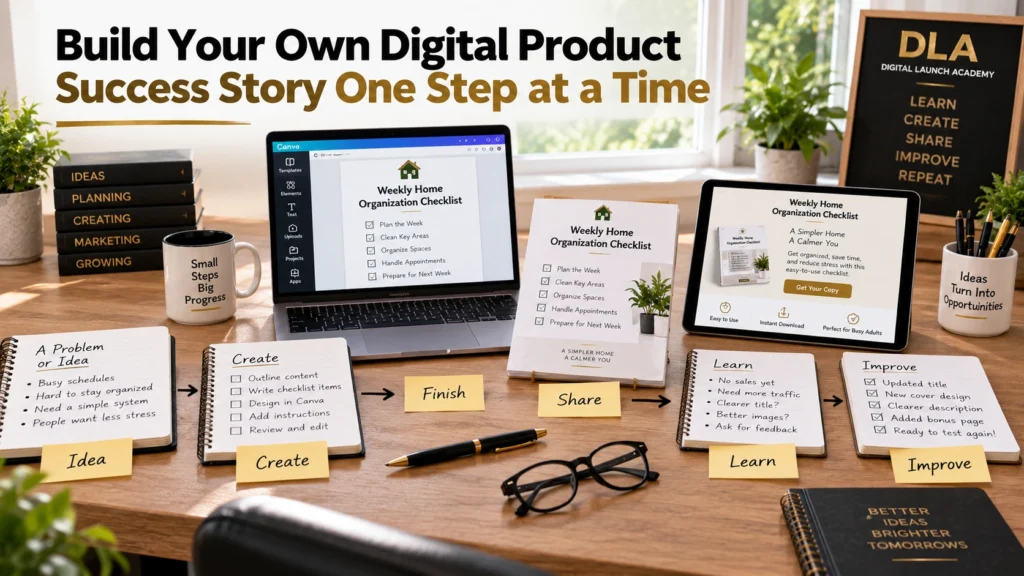
Your digital product success story does not need to look like anyone else’s.
You have your own experience, available time, skills, challenges, products, and goals.
A simple beginner journey might look like this:
- Choose a problem.
- Create a useful solution.
- Finish the product.
- Put it in front of potential customers.
- Observe the response.
- Improve what needs improvement.
- Repeat.
There is nothing flashy about that process.
That is part of what makes it useful.
Instead of trying to predict everything that could happen six months from now, concentrate on what you need to do next.
Do not measure today’s progress against someone else’s years of experience.
Measure whether you are moving forward.
Income can certainly be one of your business goals. But there is no single income level or timeline that determines whether every beginner is succeeding.
Your first meaningful success story might simply be:
“I stopped researching, chose one useful idea, created it, published it, learned from the response, and made the next version better.”
That may not sound like the dramatic success stories you see online.
But it is a real foundation.
You have moved from thinking about starting a business to actually building one.
Your Action: Write down your next single business milestone and the first action required to reach it.
Once you know that next milestone, many of the common questions about digital product success become easier to put into perspective.
Frequently Asked Questions About Digital Product Success
Can beginners really make money selling digital products?
Yes, digital products can generate revenue, but creating a product does not guarantee sales.
A useful product still needs the right audience to discover it. The offer needs to be understandable, and the product needs to solve a problem people care about.
Marketing, product quality, demand, visibility, experience, and continued improvement can all affect results.
A beginner should focus on creating something useful, getting it in front of relevant people, learning from the response, and improving from there.
How long does it take for a digital product to become successful?
There is no universal timeline.
One product may gain traction quickly while another requires months of testing and improvement. The product, market, audience, traffic, marketing strategy, creator’s experience, and available time can all affect the result.
Instead of choosing an arbitrary deadline, track meaningful indicators of progress and use what you learn to decide what needs attention next.
What is a good first digital product for a beginner?
A good first product is something manageable enough to finish and useful enough to solve one clear problem.
A checklist, planner, template, worksheet, short guide, or similar simple product can sometimes be a practical place to begin.
The best choice depends on the problem you are solving and what your intended customer needs.
Start with something you can understand, explain, create, and improve.
What if my first digital product does not sell?
Do not automatically assume you chose the wrong business.
First, try to understand why the product is not selling.
Look at traffic, the audience, the offer, product usefulness, sales messaging, pricing, and customer feedback.
If very few relevant people have seen the product, you may have a traffic problem rather than a product problem.
Identify the most likely issue, test one improvement, and use the result to determine your next step.
Do I need a large audience before selling a digital product?
You do not necessarily need an enormous social-media following.
You do need a way for relevant people to discover your product.
A smaller group of people who actually have the problem your product solves can be more useful than a large audience with little interest in your offer.
Focus on reaching the right people rather than simply chasing the largest possible follower count.
How many digital products should a beginner create?
Start by completing and learning from one useful product.
A large catalog is not automatically better.
Creating many products before learning what customers need can leave you with a collection of products that are difficult to market.
Your first product gives you an opportunity to learn about creation, customers, marketing, and selling. Use those lessons before assuming you need ten more products.
Your Success Story Starts With the Next Step
Digital product success looks different for every beginner.
Your first product is partly a product and partly a learning experience.
If it does not perform the way you hoped, the result can give you information about what to improve. If you complete a small milestone, recognize it. Those small wins help you develop the confidence and skills needed for larger ones.
You do not need to know everything before starting.
You do not need to build the perfect product on your first attempt.
And you do not need to measure your beginning against someone else’s established business.
Progress comes from doing the work, learning from what happens, making reasonable improvements, and continuing.
Your success story does not have to begin with a huge result.
It can begin with one completed step.
Your Action: Choose one step you can complete now and make that your next milestone.
Don’t Know What to Create?

Most beginners don’t fail because they lack talent.
They fail because they’re overwhelmed by too many ideas.
Download the Free Niche Planner Checklist and discover a digital product idea you can actually build.
