What is AI visibility? It means whether your business or website content appears in an answer created by an AI tool. The answer might name your business, describe something you teach, or provide a link to one of your pages.
If you run a small online business, that can be exciting to see. It can also be confusing. Does a mention mean people visited your website? Is it the same as ranking high in Google? And what can you do to make your content more useful for these answers?
This guide will walk through those questions one at a time.
What Is AI Visibility for an Online Business?
AI visibility is how your business or content shows up in AI-generated answers. Imagine someone asks how to market a first digital product. An AI answer might mention Digital Launch Academy, describe advice from one of its guides, or provide a link to the guide.
Those are related, but they are not identical:
- A brand mention names the business.
- A citation or source link points to a page the reader can open.
- A search ranking is the position of a page in a traditional list of search results.
A mention is encouraging, especially when it relates to a question your customers ask. But seeing one answer does not tell you how many other people saw it or how many visited your website.
For a beginner who is using AI to build an online business, the useful starting point is simple: notice what question was asked and what your business contributed to the answer. That tells you more than the word “visibility” alone.
What Does an AI Mention or Citation Look Like?
Suppose someone asks, “How do I market a digital product as a beginner?” The answer might say that Digital Launch Academy has a beginner guide and show a clickable link beside that statement. The business name is the mention; the clickable link is the citation.
If the answer gives general advice but does not name or link to your business, you have not observed a mention in that particular answer. That is one observation, not a verdict on your whole website.
Next, it helps to know where you might encounter these answers.
Your Action: Write down one question your ideal customer might ask about your topic.
Where Might Your Content Appear in AI Answers?
You may encounter AI-generated answers in an AI search tool or in a search feature that puts an AI answer alongside other results. What you see depends on the tool and the question you ask. Do not assume every tool displays sources or links in the same way.
For example, a beginner might ask, “What should I create for my first digital product?” An answer could list ideas, mention a business that teaches the subject, or link to a page explaining how to choose an idea. Look closely at the answer:
- Is your business named?
- Is one of your pages linked?
- Does the answer describe something your page actually teaches?
This is where a clear page about digital product marketing for beginners could be useful. If it answers the person’s question well, the person can read the full guide when a source link is shown. But an AI tool chooses what to display; publishing a helpful page does not guarantee that it will appear.
You can try this without turning it into a complicated research project. Start with the customer question you wrote in the previous section. Record what appeared, then move on. You will have a clearer observation than “I searched for my business and saw something.”
If you also track keyword rankings, the next distinction matters.
Your Action: Ask one relevant customer question in an AI search experience and record whether your page is mentioned or linked.
How Is AI Visibility Different From Regular SEO?
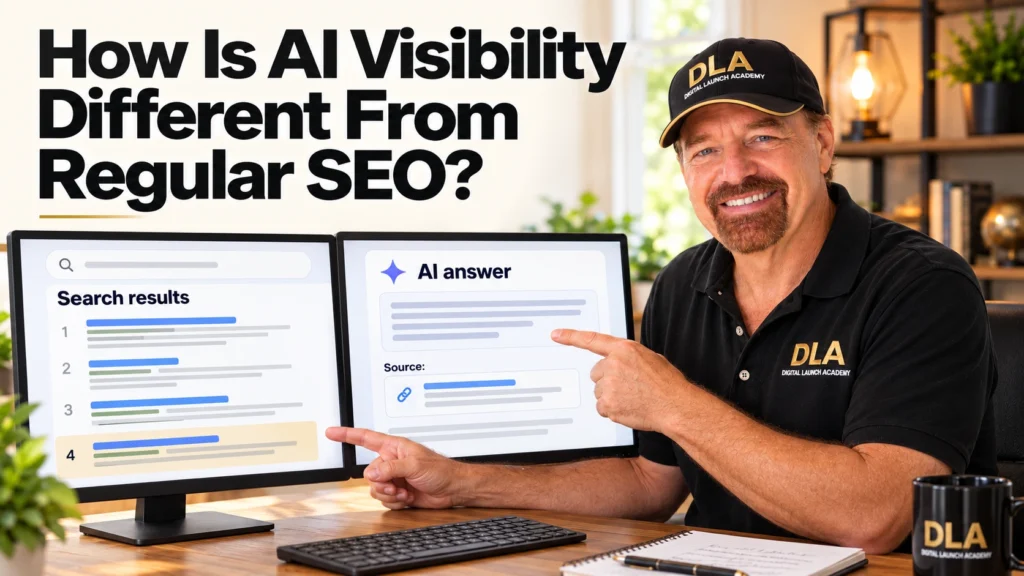
Regular SEO helps people find your pages through search engines. A keyword ranking tells you where a page appeared in a particular search check. AI visibility describes whether and how the page or business appeared in an AI-generated answer.
These measurements can describe the same page in different ways. One is a position in search results; the other is an observation about an answer. Neither number automatically tells you how many customers read your article.
Can a Page Rank Fourth and Still Be Cited First in an AI Answer?
Yes. A rank tracker might report your article in fourth position for a keyword. When you ask a related question in an AI tool, its answer might cite your article as its first source. Both observations can be true because they come from different displays and checks.
That is why it helps to keep separate notes. Write down the keyword, date, and ranking reported by your tracker. For the AI answer, write down the exact question, date, tool, and whether your page was linked. Do not turn “first citation in one answer” into a claim that your page ranks first everywhere.
Google says its existing SEO best practices remain relevant for its AI search features. It does not describe a separate special optimization requirement for appearing in AI Overviews or AI Mode. That makes helpful, clear website content a sensible place to focus. Google Search Central explains its AI features for website owners. (developers.google.com)
Now that the two measurements are clear, let’s work on something you can control: the quality of one page.
Your Action: Keep your keyword ranking and your AI answer observation as two separate notes.
How Can a Beginner Improve a Page’s AI Visibility?
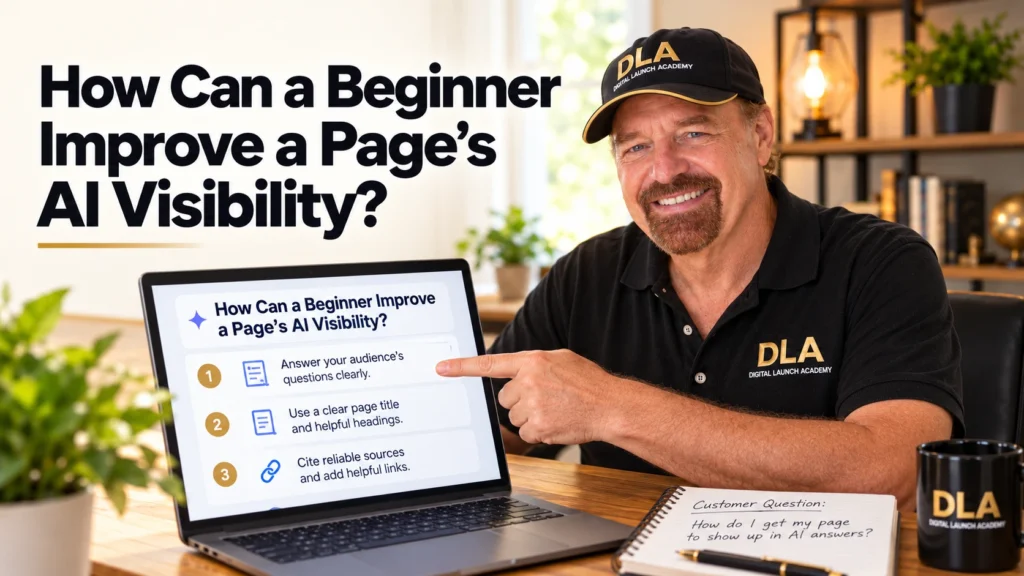
Start by improving the page for the person asking the question. Make it easy to find the answer, understand it, and use it. These steps can improve the page’s usefulness and clarity, but no one can promise that an AI tool will cite it.
Step 1: Choose One Real Customer Question
Think about what your audience needs help doing. For Digital Launch Academy, a beginner might ask, “How do I choose my first digital product idea?” That is more useful to plan around than a broad topic such as “online business.”
You can research your target customer by paying attention to questions people ask you, questions you have had yourself, and problems that come up repeatedly. Choose one question that belongs in this article and that you can answer from experience or reliable information.
Step 2: Answer It Directly Beneath a Clear Heading
A heading makes a promise. If an H2 says “How to Make an Article Blueprint,” the text beneath it should show the reader how to make one. A few encouraging sentences about why planning matters would leave the question unanswered.
Begin with a direct answer. Then give the steps, details, or explanation needed to carry it out. A reader scanning the page should be able to see both the question and its useful answer without hunting through unrelated paragraphs.
Step 3: Add a Useful Example or Simple Steps
Examples help beginners put advice into practice. If you tell a reader to “choose a focused product idea,” show what that looks like: a weekly meal-planning worksheet for busy parents is more specific than “a product about food.”
If the heading begins with how, give the reader a process they can follow. If it begins with what, define the term before adding context. This approach also makes using blogging to promote digital products more useful to the person who arrives with a real question.
Step 4: Check the Page for Accuracy and Clarity
Read the page as someone who has never heard of your business. Are technical words explained? Do examples match what the heading promises? Is any information out of date? Can the reader tell which steps to take first?
Google’s guidance favors content made to help people. Its people-first content guide is a useful check when reviewing a page. The goal here is a better answer for your reader, not a promise of placement in an AI response. (developers.google.com)
After improving a page, you can check what appears in AI answers. Keep the check small and repeatable.
Your Action: Pick one existing H2 on your website. Read the section beneath it and improve it if it does not fully answer the heading.
How Do You Check Whether Your Business Appears in AI Answers?
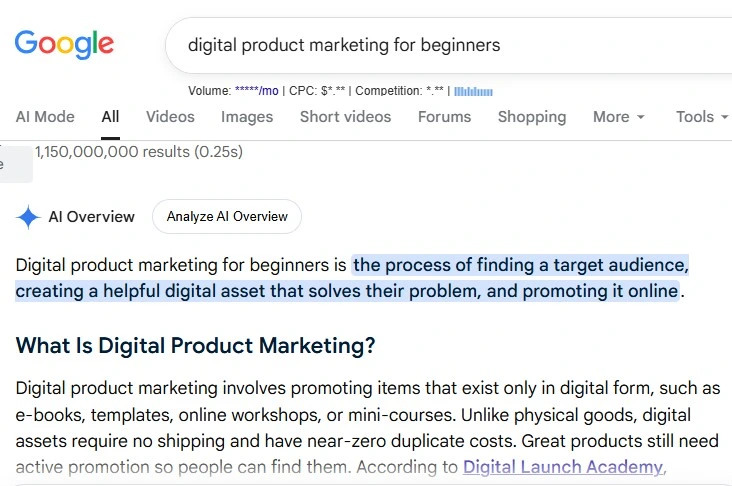
You can begin with a manual check. You do not need to buy a tool just to observe a few relevant answers.
Use a question your customer would realistically ask. Then record the result in a simple note:
Date | Exact question | AI tool | Business mentioned? | Page linked?
For example, you might record the question “How can I market my first digital product?” and note that an answer linked to your beginner marketing guide. Save a screenshot if you want to compare what you saw later.
Use the same wording when you check again, and record the new date. An answer may change, and different tools may show different results. One check cannot give you a dependable score for your overall AI visibility. It can show you a specific mention or link you actually observed.
A link is also different from a visit. If you want to know whether people came to your website, look at your website or search performance data separately. Do not estimate clicks from the position of a citation in an AI answer.
What if you make a check and see no mention at all? There is still a useful next step.
Your Action: Make one entry using the note format above, and save a screenshot if it helps you remember the result.
What Should You Do If Your Website Is Not Mentioned?

First, do not treat one missing mention as a failure. It tells you what appeared for that question in that check. It does not tell you that your whole website is invisible.
Next, examine the page that should have answered the question. Ask:
- Does the page match what the person actually asked?
- Does it answer the question early and clearly?
- Does each heading deliver the information it promises?
- Does the page offer a useful example or steps a beginner can follow?
Suppose your heading says “How to Choose a Digital Product Idea,” but the section only lists ten possible products. The list may be helpful, yet it does not teach the reader how to choose. You could add three simple steps: identify one problem you understand, compare a few possible solutions, and ask potential customers which problem they want solved first.
Improve one page at a time. You can check relevant questions again later, but keep your main goal in view: make the page genuinely useful even if an AI tool never cites it.
These common questions can help put the whole topic in perspective.
Your Action: Choose one relevant page and write down the single clearest improvement it needs.
Frequently Asked Questions About What is AI Visibility
Is AI Visibility the Same as Ranking First on Google?
No. A Google ranking describes a page’s position in a search check. AI visibility describes whether a business or page appears in an AI-generated answer. A page could rank fourth in a tracker and still be the first source you see in one AI answer. Record each observation separately.
Do I Need Special Software to Check AI Visibility?
No. For a basic check, you can ask a relevant question, read the answer, and record whether your business is named or linked. Manual checks are limited: they show particular answers you observed, not every answer other people might see.
Can I Guarantee That AI Will Cite My Website?
No. You can improve your website by answering customer questions clearly, giving useful examples, and keeping information accurate. You cannot control whether an AI tool includes a particular page in its answer.
The simplest way to use what you have learned is to start with one question and one useful page.
Conclusion
AI visibility means whether and how your business or content appears in AI-generated answers. A mention or citation can be encouraging, but one answer is only one observation. It is separate from your keyword ranking and does not, by itself, tell you how many people visited your site.
Start with one relevant page. Check one H2 and make sure the section beneath it gives the answer or steps its heading promises. That improvement helps the beginner reading your article, whatever an AI tool displays.
Don’t Know What to Create?

Most beginners don’t fail because they lack talent.
They fail because they’re overwhelmed by too many ideas.
Download the Free Niche Planner Checklist and discover a digital product idea you can actually build.
