
Learning how to get your first digital product sale can feel like a completely different challenge from creating the product itself. You may have spent days or weeks making a printable, template, guide, workbook, planner, or another digital product. Now you have a new question: How do I get someone to actually buy it?
The good news is that you do not need to become a marketing expert before you can start looking for your first customer. You also do not need to promote your product on every social media platform at the same time.
Your first goal can be much smaller.
You need a product that solves a clear problem, an offer people can understand, and a simple way to put that offer in front of people who may need it.
Here are seven steps that can help you work toward that first sale without making the process more complicated than it needs to be.
Step 1: Make Sure Your Digital Product Solves One Clear Problem

Before worrying about marketing, take another look at the product itself.
People usually are not buying a PDF, spreadsheet, Canva template, or collection of pages simply because those files exist. They are buying what those files can help them accomplish.
Your product might help someone save time, get organized, learn something, plan an event, keep track of information, or complete a task more easily.
That problem does not have to be huge.
A small problem with a useful solution can be enough for a beginner digital product.
Ask What Your Product Helps Someone Do
Try completing this sentence:
This product helps _____ do _____.
If you struggle to finish that sentence, your potential customer may also struggle to understand why they need the product.
For example, describing something as a “25-page printable planner” tells the customer what the product contains. It does not clearly explain why those pages are useful.
A clearer description might be:
A weekly meal planner that helps busy families decide what to cook and organize their grocery list.
Now the customer can see the purpose.
Keep the First Product Simple
It can be tempting to add more when you are worried that a product is not good enough.
You might add another worksheet, five bonus pages, extra templates, or an entire second product.
More is not automatically better.
If the basic product already solves the customer’s problem, adding more material can sometimes make the offer harder to understand.
For your first digital product sale, clarity matters more than creating the biggest product possible.
Your Action: Write one sentence:
My product helps __________ do __________.
Do not move on until you can explain the purpose of your product clearly.
Once you know exactly what your product helps someone accomplish, the next question is simple: Who needs that help?
Step 2: Identify Who Is Most Likely to Buy Your Product
One of the easiest ways to make marketing difficult is trying to sell your product to everyone.
Your first customer is not “everyone.”
Your first customer is one person who has a problem your product can help solve.
You do not need to create a complicated customer profile before you begin. Start by thinking about the problem.
Start With the Problem, Not Demographics
Age, location, occupation, and other details can sometimes be useful. But they do not automatically tell you why someone would buy your product.
Suppose you created a retirement-planning printable.
Saying your customer is “people over 50” is very broad. Plenty of people over 50 may have no interest in your product.
Instead, think about people who are actively trying to organize retirement information, prepare important documents, or keep retirement planning details in one place.
Now you are thinking about the need that could lead someone to buy.
Ask Where Those People Already Spend Time
Once you know who might need the product, ask where those people look for information about the problem.
That could include:
- Search engines
- YouTube
- Facebook groups where promotion is permitted
- Online communities
- An email audience you already have
- Relevant personal or professional networks
You are not trying to reach thousands of people immediately.
You are trying to identify a realistic group of people who have a reason to care about what you created.
Your Action: Write down the answers to these three questions:
- Who is this product for?
- What problem are they trying to solve?
- Where might they look for help with that problem?
Now you know who you want to reach. The next step is making sure those people understand what you are offering.
Step 3: Make Your Digital Product Offer Easy to Understand

Having a useful product and having a clear offer are not exactly the same thing.
You know everything about the product because you created it. A new visitor does not.
When someone reaches your product page, they should quickly be able to understand:
- What the product is
- Who it is for
- What it helps them accomplish
- What they receive
- What it costs
- How they get it
If those answers are difficult to find, the customer may leave before deciding whether the product could help them.
If you want to understand the complete process from creating your offer to reaching customers, read my guide to selling digital products online.
Explain the Benefit Before the Features
Features describe what is included.
Benefits explain why those features matter.
For example:
Vague:
“Includes 20 printable planning pages, five worksheets, and three bonus pages.”
That tells the customer what is inside, but not why they need it.
A clearer version might be:
“Organize your weekly meals, grocery list, and meal-preparation notes in one simple printable planner.”
You can still explain the individual pages later. First, help the customer understand the result.
Check Your Product Page Like a Beginner
Try to forget everything you know about your product for a moment.
Look at the page as if you had never seen the product before.
Ask yourself:
Would I understand what this is within a few seconds?
Do not assume customers understand something simply because it seems obvious to you.
Clear beats clever.
A simple headline and straightforward explanation are usually more helpful to a beginner than creative wording that makes the visitor figure out what is being sold.
Your Action: Read your product page from top to bottom and ask:
Would a stranger understand what I am selling, who it helps, and what they get?
Find the biggest point of confusion and fix that one thing before continuing.
Once your product and offer are clear, you need to start getting that offer in front of potential customers.
Step 4: Choose One Place to Promote Your First Digital Product
A beginner can easily turn marketing into a full-time job.
You create a Facebook page. Then you hear that you need Instagram. Someone recommends Pinterest. Another person says YouTube is better. Then you hear about TikTok, blogging, and email marketing.
Before long, you are trying to learn six different platforms instead of promoting your product.
You do not need to do that.
Choose a Platform That Fits Your Customer
Start with one primary place where people who might need your product already look for information or ideas.
The best starting place depends on your product and customer.
For example, a printable creator might choose Pinterest if the product naturally fits visual search, organization, planning, or ideas people save for later.
Someone teaching a topic people regularly research might decide that blogging or YouTube makes more sense.
The important question is not:
Which platform is the most popular?
It is:
Where am I most likely to reach people interested in the problem my product solves?
Do Not Try to Master Everything at Once
Choosing one primary traffic source does not mean you can never use another platform.
It simply gives you somewhere to start.
If you post once on six platforms and then disappear because the workload becomes overwhelming, you have not given yourself much opportunity to learn what works.
Starting with one platform allows you to practice, observe the response, and improve.
Your Action: Choose one primary place where you will begin promoting your product.
Write it down.
Now you have somewhere to show up. The next question is what you should say when you get there.
Step 5: Help Before You Ask People to Buy

If every piece of content says “buy my product,” people have very little reason to pay attention.
A better approach is to begin by being useful.
Helpful content can answer a question, solve part of a problem, demonstrate something, teach a simple process, or help someone recognize a problem they need to solve.
This also gives potential customers an opportunity to learn from you before deciding whether they want to buy from you.
Create Content Around the Problem Your Product Solves
Work backward from your product.
Ask:
What questions would someone have before they needed this product?
Suppose you sell a weekly meal-planning printable.
You could create helpful content about:
- Planning five dinners for the week
- Making a grocery list before shopping
- Organizing meals around a busy schedule
Those topics are directly connected to the problem the product solves.
Connect Helpful Content to the Product Naturally
You do not have to hide the fact that you sell something.
The important part is making the product relevant to the content.
For example, you might teach someone how to choose five dinners for the coming week. After helping them with that step, you can explain that your meal-planning printable gives them a place to organize those meals and create their grocery list.
The product becomes a natural extension of the lesson instead of an unrelated sales pitch.
That is very different from posting a random sales message and hoping someone buys.
Your Action: Write down three questions your potential customer might ask about the problem your product solves.
Choose one question as the subject of your next piece of helpful content.
Helpful content can create awareness and trust. But eventually, someone still needs to know that your product is available to buy.
Step 6: Ask for the Sale With a Simple, Clear Offer
Many beginners feel uncomfortable with this part.
You may be perfectly comfortable helping someone but feel like you are being pushy as soon as you mention your product.
Selling does not have to mean pressuring someone.
If your product genuinely helps with the problem you are discussing, telling people that it exists can be useful.
Tell People What the Product Helps Them Do
Keep your sales message connected to the customer’s problem and the result they want.
You do not need a complicated pitch.
For example, after teaching a useful meal-planning tip, you might say:
“If you want a simple way to organize your meals and grocery list each week, the weekly meal planner was created to help you do that.”
That is clear without being aggressive.
You have explained the problem, provided useful information, and told the person that there is a product available if they want additional help.
Give Them One Clear Next Step
Do not make someone guess what to do next.
If you are presenting a product offer, the next step should be obvious.
Too many choices can create unnecessary confusion. Keep the path simple.
And do not apologize for selling something you believe is genuinely useful.
You created the product to help solve a problem. It is reasonable to explain what it does and give interested people an opportunity to buy it.
Your Action: Write one simple sentence that explains:
What the product helps with + who it is for + what the person should do next.
You now have the basic pieces needed to work toward your first sale. If that sale does not happen immediately, the next step is learning from what happened.
Step 7: Learn From the Response and Keep Improving
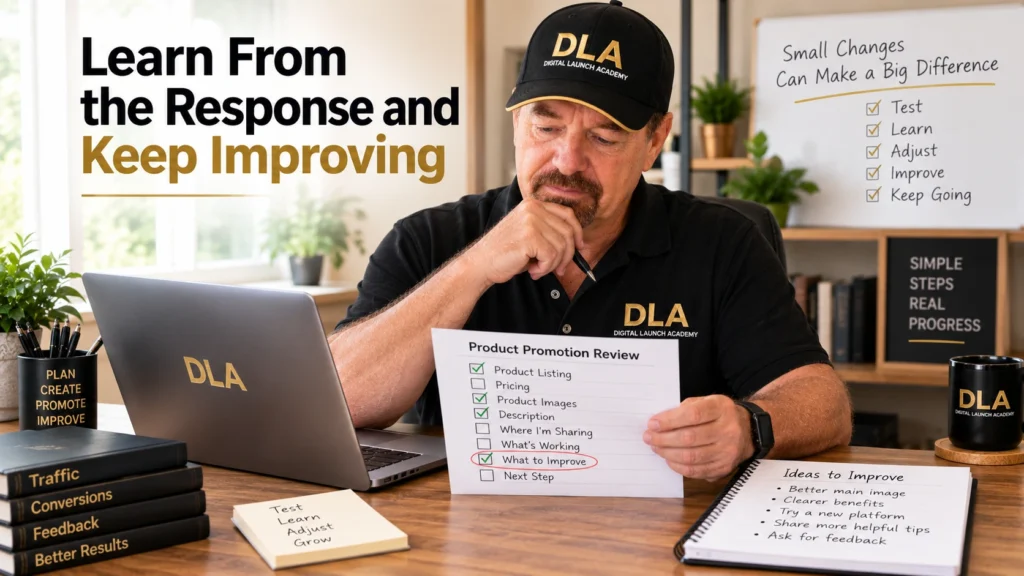
You can follow every step in this article and still not make a sale the first time you promote your product.
That does not automatically tell you what is wrong.
There are several possibilities.
Maybe not enough people have seen the product yet.
Maybe the wrong people are seeing it.
Perhaps the product benefit is unclear, the sales page is confusing, the price or offer needs another look, or your marketing message is not connecting with the people you are trying to reach.
You may also need more time to create useful content and build trust.
Do Not Change Everything at Once
Suppose you promote your product and get no sales.
You change the price, rewrite the sales page, change the product name, add a bonus, switch platforms, and redesign the product.
Then you make a sale.
What worked?
You do not know because you changed everything.
Instead, look for the part of the process that appears weakest and make one meaningful improvement.
Look for the Weakest Step
Use this simple sequence:
Product → Audience → Offer → Traffic → Message → Response
Start at the beginning.
Does the product solve a clear problem?
Are you showing it to people who have that problem?
Is the offer easy to understand?
Are enough appropriate people seeing it?
Does your message explain why the product is useful?
What response are you getting?
If people are not seeing the offer, changing the price may not solve anything. If people are visiting the product page but seem confused about what the product does, getting more traffic may not solve the real problem either.
Your early results give you information.
Use that information to decide what to improve next.
Your Action: After promoting your product, write down:
- Where you promoted it
- Approximately how many people had an opportunity to see it, if you know
- Whether people clicked or showed interest, if that information is available
- One thing you may test or improve next
Change one meaningful thing at a time.
Frequently Asked Questions About How To Get Your First Digital Product Sale
How long does it take to get your first digital product sale?
There is no reliable timeline that applies to everyone.
The time it takes can depend on the product, demand, audience, traffic, offer clarity, trust, pricing, and how consistently you promote it.
One beginner may already have an audience interested in the topic. Another may be starting with no audience at all.
Instead of setting an arbitrary deadline, concentrate on getting the right people to see a clear and useful offer.
Do I need a large audience to make my first sale?
No large audience is automatically required.
What matters is whether the people seeing your product are actually interested in the problem it solves.
A small group of relevant potential customers can be more useful than a large audience with little interest in your product.
Focus first on reaching the right people rather than chasing the biggest number.
What if nobody buys my digital product?
Do not immediately assume the product is bad.
Work through the process one step at a time.
Ask whether the product solves a useful problem, whether the right audience is seeing it, whether your offer is clear, whether enough people have had an opportunity to see it, and whether your marketing message explains the benefit.
Then choose the weakest area and test one improvement.
Should I lower my price if I am not getting sales?
Not automatically.
A lack of sales does not prove that your price is the problem.
If only a few people have seen your product—or the people seeing it are not your likely customers—changing the price may accomplish very little.
Before lowering the price, make sure appropriate potential customers are seeing the offer and can clearly understand what they will receive and how it helps them.
Do I need paid ads to get my first digital product sale?
No. Paid advertising is not a requirement for making a first digital product sale.
A beginner can start with an appropriate organic traffic method and use helpful content to reach potential customers.
This also gives you time to learn which messages and topics connect with your audience before adding more complicated marketing methods.
Your First Digital Product Sale Starts With One Customer
Your first digital product sale is not about reaching everyone.
It is about reaching one person who has a problem your product can genuinely help solve.
Start with a clear product. Identify the people who may need it. Make the offer easy to understand. Choose one place to promote it. Create useful content around the problem. Give interested people a clear opportunity to buy.
Then pay attention to what happens.
If the first promotion does not produce a sale, use the response as information rather than changing everything at once.
You do not need to master every marketing platform or build a complicated sales system before you begin.
Start with one product, one audience, one primary way to reach them, and one useful message.
Then take the next step from there.
Don’t Know What to Create?
Most beginners don’t fail because they lack talent.
They fail because they’re overwhelmed by too many ideas.
Download the Free Niche Planner Checklist and discover a digital product idea you can actually build.
