
You do not need to guess which digital product will sell. The five ways to validate ideas in this guide help you find out whether people actually want your planner, checklist, tracker, template, or guide before you spend days making it in Canva.
That matters because a good-looking product is not always a needed product. Validation simply means checking for proof that a real problem exists. You are looking for small clues that people are searching, asking, buying, or talking about the help your product could provide.
You do not need a big audience, fancy software, or marketing experience. Start small. A few honest answers can save you a lot of time.
Why validate a digital product idea first?
Many beginners start by creating the product they personally like best. That is not wrong. But if no one else needs it, you may finish a beautiful file and feel disappointed when it does not sell.
When you validate a product idea first, you make decisions based on real people instead of hopes. You learn what problem to solve, what words buyers use, and what details they care about. This also makes writing your product title and description much easier later.
For example, “a meal planner” is a broad idea. After simple research, you may find that people are specifically asking for a low-cost weekly meal planner for busy families, a diabetic meal tracker, or a pantry inventory checklist. Those are clearer product ideas because they help a specific person with a specific task.
Simple action: Write down one product idea you are considering. Do not create it yet.
1. Start with a problem you understand
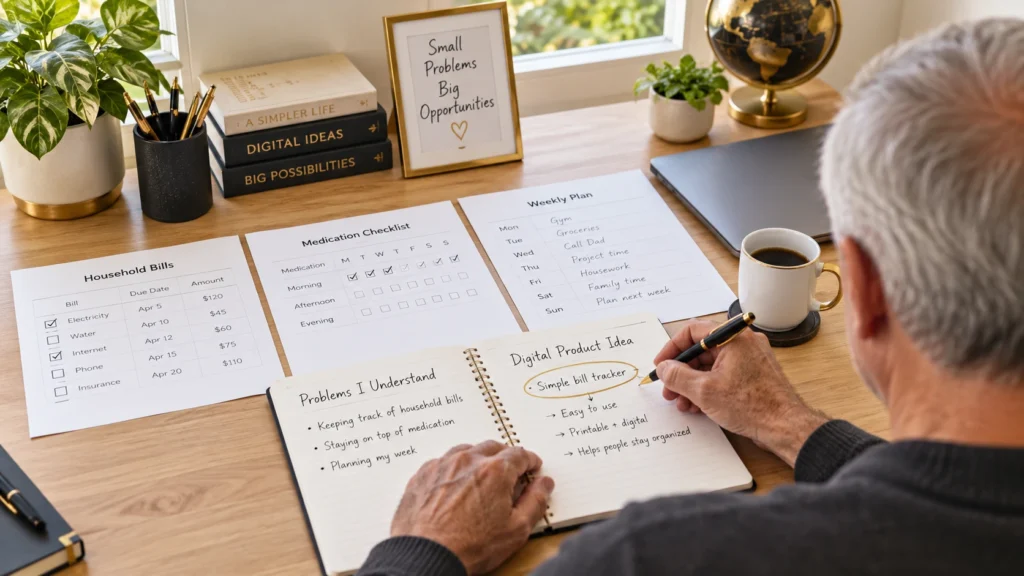
The easiest digital product ideas often begin with a problem you have faced yourself. Think about something that used to feel messy, stressful, expensive, or hard to remember.
Maybe you needed a way to track bills after retirement. Maybe you wanted a simple weekly cleaning routine while working full-time. Maybe you struggled to organize medications, plan holiday spending, or prepare for a family vacation.
Your own experience does not prove that a product will sell. It does give you a useful starting point. You understand the situation, the emotions behind it, and the simple result the person wants.
Use this sentence to shape your idea:
> I want to help [type of person] go from [frustrating problem] to [simple result].
Here are a few examples:
- Help busy moms go from forgotten school tasks to an organized weekly routine.
- Help retirees go from scattered medical notes to a clear medication record.
- Help new dog owners go from feeling unprepared to following a simple puppy care checklist.
- Help side-hustlers go from random expenses to tracking business spending each month.
Keep the problem small. A beginner does not need to create a 100-page course or a giant bundle. A one-page checklist that solves one annoying problem can be useful.
Use AI to find clearer product angles
If you have a broad idea, ask AI to help you narrow it down. You can type this prompt:
> Give me 20 simple digital product ideas for people who struggle with [your topic]. Include planners, trackers, checklists, templates, and short guides. Focus on small everyday problems.
Read the ideas and circle the ones that feel practical. You are not asking AI to choose for you. You are using it to see more options.
Simple action: Complete the sentence, “I want to help…” for your best idea.
2. Look for questions people are already asking
One of the best ways to find out what people need is to pay attention to their questions. When someone asks, “How do I keep track of this?” or “Does anyone have a simple way to organize that?” they may be describing a product opportunity.
Search for your topic on places where people have conversations, such as Facebook groups, Pinterest, YouTube comments, online forums, or Google search suggestions. You are not there to post a sales message. You are there to listen.
For example, if your idea is a home cleaning planner, look for phrases such as:
- “How do I keep up with housework while working?”
- “What should I clean every week?”
- “I need a realistic cleaning schedule.”
- “How do I get my family to help with chores?”
Write down the exact words people use. Their language is valuable. A buyer may search for “weekly cleaning checklist” instead of “home management system.” Use the simple words your future customer already understands.
Pay special attention to repeated frustrations. One person asking for help is interesting. Ten people describing the same problem is stronger proof that your digital product idea may have demand.
What to look for during simple market research
You do not need to become a market research expert. Look for three signs: people have a clear problem, they want an easier solution, and they use similar words when they describe it.
Also notice what is missing. Perhaps people share complicated spreadsheets, but beginners say they want something printable. Maybe existing planners are too pretty to write on, too detailed, or made for the wrong type of customer. Those gaps can guide your product.
Simple action: Find five real questions or complaints related to your idea and copy them into a notes document.
3. Check whether similar products are being sold

Looking at similar products is not copying. It is a smart way to validate a business idea. If people are already selling related digital downloads, it shows buyers understand the type of product.
Search online marketplaces for your product phrase. Try several versions of the same search. For example, instead of only searching “budget planner,” also search “monthly budget worksheet,” “bill payment tracker,” “debt payoff printable,” and “simple budget template.”
Open a few listings and study them like a student. Notice the product format, the number of pages, the buyer it serves, and the problems it promises to solve. Read customer reviews when they are available. Reviews often reveal what buyers loved and what they wished had been included.
Do not let competition scare you. No competition can sometimes mean there is little interest. Some competition is healthy because it suggests people are spending money in that area.
The goal is not to make the exact same thing. Your goal is to make a simpler, more focused, or better-fitting version for a certain group of people. A general fitness tracker has many competitors. A gentle walking tracker for adults over 60 has a clearer audience.
Avoid the “too many products” trap
You may see hundreds of similar products and think the idea is taken. Usually, it is not. Buyers have different needs, styles, budgets, and life situations.
Instead of asking, “Has anyone made this before?” ask, “Can I make this easier for one type of person?” That question leads to better product ideas for beginners.
Simple action: Review 10 similar products and write down one improvement you could make without adding complexity.
4. Ask real people for a simple opinion
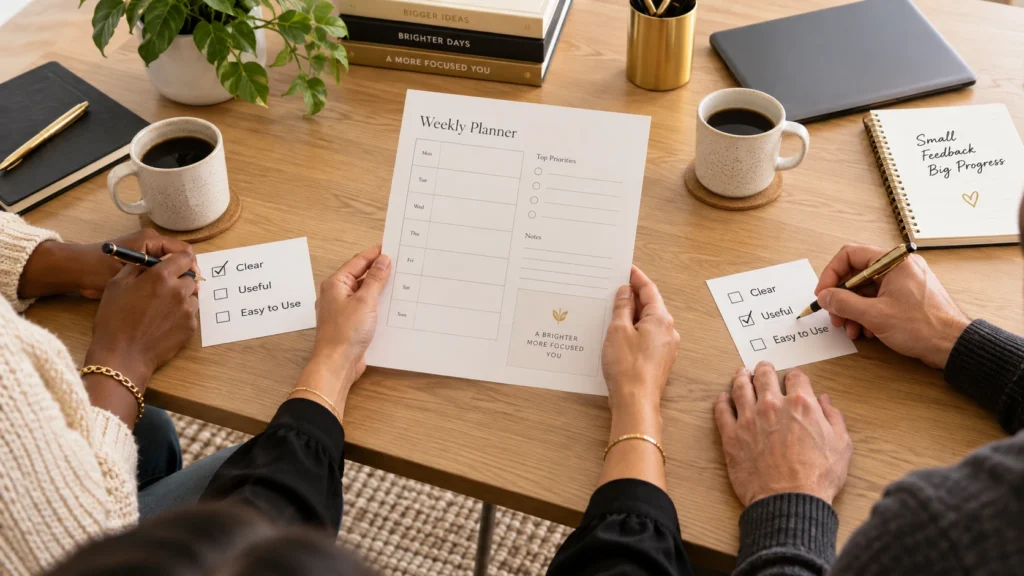
You do not need thousands of followers to test a product idea. Start with people you already know who match the type of buyer you want to help. This could be friends, coworkers, family members, or members of an appropriate online group where questions are allowed.
Do not ask, “Would you buy this?” People often say yes because they want to be kind. Ask about their problem instead.
Try questions like these:
- What is the hardest part about keeping track of your weekly meals?
- How do you handle this now?
- Have you tried a planner, checklist, or app before?
- What did you dislike about it?
- What would make this easier for you?
Listen more than you explain. If someone says they need more pages, do not immediately add more pages. Ask why. They may really need larger writing spaces, fewer categories, or a clearer routine.
Even three to five conversations can teach you a great deal. You may discover that your original idea is useful but needs a different name or a smaller focus.
Simple action: Ask three people one question about the problem your product will solve.
5. Test a small version before making the full product
This is where many people save the most time. Instead of building a 30-page planner, create one sample page, a mini checklist, or a basic version first.
For example, if you want to sell a moving planner, make a one-page “Two Weeks Before Moving” checklist. If you want to create a gardening journal, make one weekly garden task page. Design it simply in Canva. Use large, easy-to-read text and leave room for writing.
Then show the sample to a few people who have the problem. Ask them whether it is clear, useful, and easy to use. You can also offer the sample free in exchange for honest feedback. Make it clear that you want suggestions, not compliments.
If people use the sample and ask for more, that is a strong sign. If they seem confused or uninterested, that is useful too. It does not mean you failed. It means you learned before investing more hours.
You can also test your product title. Try two simple names and ask which one makes the purpose clearer. “The Calm Home Planner” may sound nice, but “Weekly Cleaning Checklist for Busy Moms” tells the buyer exactly what it is.
What counts as enough proof?
There is no perfect number. You are not trying to remove every risk. You are trying to make a better first decision.
A good beginner sign is when you see several pieces of evidence together: people ask about the problem, similar products are selling, and a few real people understand or want your sample. That is enough to begin creating a small finished version.
Simple action: Create one sample page in Canva this week and ask for feedback before building the rest.
Choose progress over perfect proof
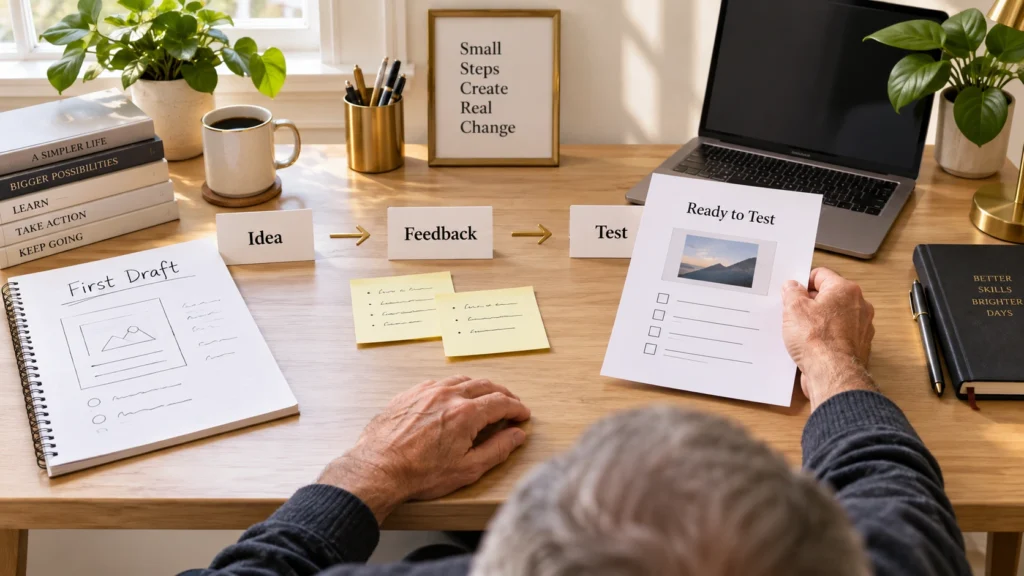
You may still feel nervous after validating your idea. That is normal. No amount of research can guarantee sales, and you do not need a guarantee to take the next step.
Use what you learned to create a simple product that solves one clear problem. Keep your first version small. Then improve it as you learn more from real buyers and real feedback. One helpful page can be the beginning of extra income, and you are fully capable of starting there.
Frequently Asked Questions About Five Ways to Validate Ideas
What does it mean to validate a digital product idea?
Validating a digital product idea means looking for evidence that real people need or want the product before you create the complete version. You can study customer questions, review similar products, talk with potential buyers, and test a small sample.
Why should I validate my idea before creating the product?
Validation can help you avoid spending days creating a product that people may not need. It helps you understand the customer’s problem, the words they use, and the type of solution they want.
Do I need a large audience to validate an idea?
No. You can begin with three to five people who experience the problem your product will solve. You can also study questions and comments on Google, YouTube, Pinterest, Facebook groups, and online marketplaces.
How can I tell whether a digital product idea has demand?
Look for several signs together. People should be asking questions about the problem, similar products should already be available, and potential customers should show interest in your sample. One sign alone is not proof, but several signs can help you make a better decision.
Should I create the complete product before asking for feedback?
No. Create a small sample first, such as one worksheet, checklist, planner page, or template. Show it to a few potential customers and ask whether it is clear, useful, and easy to use.
What should I do if people do not like my first idea?
Use their feedback to improve or narrow the idea. You may need to change the title, simplify the product, focus on a different customer, or solve a smaller problem. Learning this before creating the full product saves time and is not a failure.
Don’t Know What to Create?

Most beginners don’t fail because they lack talent.
They fail because they’re overwhelmed by too many ideas.
Download the Free Niche Planner Checklist and discover a digital product idea you can actually build.
