Marketing can feel like the most confusing part of selling a digital product.
You may know how to create a printable, Canva template, ebook, checklist, workbook, or online course. But once the product is finished, a new question appears: How will anyone find it?
The good news is that you do not need expensive advertising, advanced technical skills, or thousands of social media followers to begin. Digital product marketing starts with understanding one group of people, solving one useful problem, and consistently helping those people discover your solution.
In this guide, you will learn what digital product marketing means, why good products still need promotion, which beginner-friendly strategies you can use, and how to build a simple plan for getting your first customers.
What Is Digital Product Marketing?
Digital product marketing is the process of helping the right people discover, understand, and purchase your digital product.
Your product might be:
A printable planner
A Canva template
An ebook
A workbook
A checklist
A digital course
A prompt pack
A spreadsheet
A downloadable guide
Marketing connects that product with people who already have the problem it solves.
It does not begin with advertising or repeatedly telling strangers to buy something. It begins by answering three basic questions:
Who is the product for?
What problem does it solve?
Why would someone choose it?
Suppose you create a printable weekly meal planner for busy parents.
The planner may be attractive, organized, and easy to use. But customers will not automatically know it exists. They need a way to discover it.
You might write a helpful article about planning five family dinners for the week. You could create a Pinterest pin that leads to the article. At the end of the article, you could offer a free grocery-list checklist. That free checklist could introduce readers to your paid meal planner.
Each step helps the right person move closer to your product.
That is digital product marketing in plain English: connecting a helpful product with someone who needs it.
Creating and marketing are different jobs
Creating is the work of making the product.
Marketing is the work of helping people find and understand it.
Many beginners spend weeks perfecting fonts, colors, layouts, and page designs. They finish the product and then realize they have not planned how anyone will discover it.
This does not mean you should stop improving your products. It means marketing needs a place in your weekly business routine.
Marketing works best when it feels like teaching.
Instead of repeatedly saying, “Buy my product,” you can:
Answer common questions
Demonstrate simple solutions
Share helpful tips
Explain a process
Show how your product solves a problem
Give people a useful next step
You can also use tools such as Google Trends to explore interest in a topic before creating content around it. Google Search Central provides guidance for creating useful, people-first website content.
For help with the product-creation side of the process, read How to Create Your First Digital Product before building a large marketing plan.
Your Action
Write one sentence describing who your digital product helps and what problem it solves.
Use this simple format:
My product helps _______ solve _______.
Keep the sentence clear. You do not need clever marketing language yet.
Now that you understand digital product marketing, the next step is understanding why even a great product needs promotion.

Why Great Products Still Need Marketing
A useful product is important, but quality alone does not guarantee sales.
People must first discover the product. Then they need to understand it, trust the person selling it, and believe it can help them.
Imagine opening a beautiful store on a quiet road where almost no one drives.
The products inside may be excellent. The displays may be attractive. The prices may be fair. But if people do not know the store exists, sales will remain low.
Marketing is how you guide people toward the store.
Three elements are especially important: visibility, trust, and consistency.
Visibility
Visibility means placing your product where potential customers can find it.
You can build visibility through:
Helpful blog posts
Google search results
Pinterest pins
YouTube videos
Email newsletters
Social media posts
Online marketplaces
Partnerships
Guest interviews
You do not need to use every platform.
One well-managed traffic source is more useful than six abandoned accounts. Beginners often lose momentum because they try to create content for Google, Pinterest, YouTube, Facebook, Instagram, TikTok, and email at the same time.
Choose one main channel first.
Trust
Most people will not buy immediately after discovering you.
They may read several articles, watch a video, download a free resource, or join your email list before making a purchase.
Helpful content builds trust because it lets people experience your teaching before spending money.
When your free information is clear and useful, readers are more likely to believe your paid product will also help them.
Trust also grows when you make honest promises.
Avoid suggesting that one printable, course, or prompt pack will immediately transform someone’s income. Explain what the product does, who it helps, and what the customer must do to receive the result.
Clear expectations create stronger customer relationships.
Consistency
Marketing usually works through repeated, useful contact.
One blog post may not produce a sale immediately. However, a growing collection of helpful articles can continue bringing visitors to your website for months or years.
One email may not create a buyer. A short sequence of useful emails can build familiarity and confidence.
Consistency does not mean publishing every day.
It means choosing a realistic schedule and following it.
A beginner might publish:
One helpful blog article each week
Two Pinterest pins connected to the article
One email newsletter
One short YouTube lesson
Another beginner might publish only one article every two weeks. That can still work if the schedule is realistic and the content is useful.
Marketing is not about convincing people to buy something they do not need. It is about helping the right person discover a solution that may make life easier.
Before promoting a product heavily, make sure it serves a focused audience. How to Choose a Profitable Niche Without Feeling Overwhelmed can help you clarify who you want to reach.
Your Action
List three places where your ideal customer already spends time online.
Examples include:
Google
Pinterest
YouTube
Facebook groups
Etsy
LinkedIn
Industry-specific websites
Do not choose your marketing platform yet. First, identify where your audience already looks for information.
Now let’s examine beginner-friendly marketing strategies you can use to reach those people.
Simple Digital Product Marketing Strategies for Beginners

The number of available marketing platforms can make you feel as though you must be everywhere.
You do not.
Choose one primary strategy that fits your skills, schedule, product, and audience. Learn how it works before adding another.
Here are several beginner-friendly options.
Blogging and SEO
Blogging allows you to answer questions your potential customers are already asking.
A person may search Google for:
How to plan weekly meals
How to organize medication
How to create a household budget
How to start selling printables
How to make a Canva template
How to choose a digital product niche
A useful article can answer the question and naturally introduce a related product.
Search engine optimization, commonly called SEO, helps search engines understand what your article is about.
Basic SEO includes:
A clear article title
A focused keyword
Helpful headings
Useful explanations
Relevant internal links
A readable URL
A clear meta description
SEO can take time, but a strong article may continue bringing people to your website long after you publish it.
If you also want to understand how a page might appear in an AI answer, read our beginner’s guide to AI visibility.
Blogging is a good option for people who enjoy writing, teaching, and explaining ideas in detail.
Pinterest works more like a visual search engine than a traditional social media platform.
People use it to find:
Planners
Templates
Recipes
Checklists
Worksheets
Tutorials
Business ideas
Home organization resources
That makes Pinterest a natural platform for many digital products.
A basic Pinterest pin usually includes:
A clear image
A short headline
A simple description
A link to a blog post, product page, or free resource
You can create pins in Canva using a reusable template. The design does not need to be complicated.
Readable text and a clear promise are more important than decorative elements.
Pinterest may work well for visual products such as printables, planners, templates, and workbooks.
Email Marketing
An email list gives you a direct way to communicate with people who have chosen to hear from you.
You can invite visitors to join your list by offering a useful free resource, often called a lead magnet.
Examples include:
A checklist
A one-page planner
A short guide
A template
A worksheet
A quick-start plan
After someone joins, you can send:
Helpful lessons
Practical tips
Product updates
New articles
Occasional offers
Unlike a social media account, your email list is not controlled by a changing algorithm.
You can reach subscribers directly.
For a simple step-by-step approach, follow How to Build an Email List for Digital Products.
YouTube
YouTube works well when your audience benefits from demonstrations.
You can create:
Canva tutorials
Product walkthroughs
Screen-sharing lessons
Simple business explanations
Answers to beginner questions
Short step-by-step demonstrations
You do not need a professional studio.
Clear sound, a readable screen, and patient instruction are enough to begin.
One video can also support other marketing channels. You can turn the main lesson into:
A blog article
An email
Several short videos
A checklist
Social media posts
This helps you get more value from the work you already completed.
Social Media
Social media can help build awareness, but it can also consume a great deal of time.
Choose a platform because your audience uses it, not because someone told you every business must be there.
Use social media to:
Answer common questions
Share short tips
Demonstrate your product
Announce new content
Direct people to your website
Invite people to join your email list
Avoid spending all your time creating posts that disappear within hours.
Whenever possible, combine social media with content that lasts longer, such as blog posts, YouTube videos, or email resources.
If you are ready to put these ideas into action, follow this step-by-step guide to marketing your first digital product and build a simple plan you can actually follow.
How One Article can Support the Whole System
Suppose you sell a printable niche-planning worksheet.
You publish an article titled How to Choose a Profitable Niche Without Feeling Overwhelmed.
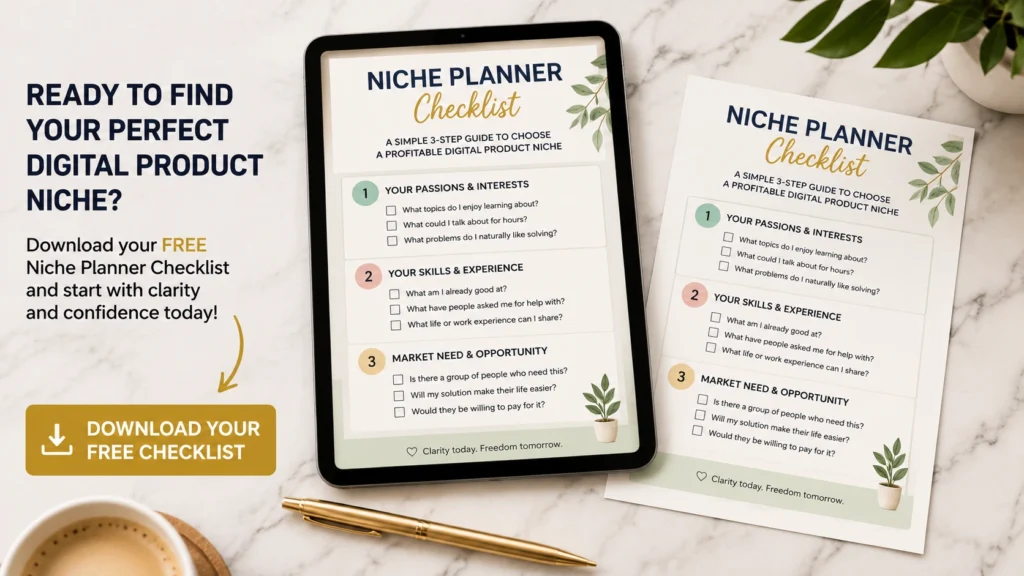
Inside the article, you offer a free Niche Planner Checklist.
The reader downloads the checklist and joins your email list.
Over the next several days, you send helpful lessons about choosing and validating an idea. Later, you introduce a paid starter product that helps the reader continue.
One helpful article now supports:
Search traffic
Your lead magnet
Your email list
Your paid offer
Future social posts
A possible YouTube lesson
That is a simple digital product marketing system.
Your Action
Choose one marketing strategy to focus on for the next 30 days.
Write down:
The platform you will use
The type of content you will create
How often you can realistically publish
Do not add a second platform until you have practiced the first one consistently.
Next, let’s use your chosen strategy to attract your first customers.
How to Get Your First Customers
Your first customers are unlikely to appear because you posted one product link.
They usually arrive after you have solved a problem, answered a question, or built enough trust for someone to take the next step.
Start small.
Your first customer is more important than rapid growth because that first sale teaches you how someone discovers, evaluates, and purchases your product.
Solve one specific problem
Broad messages are easy to ignore.
“Improve your life” is vague.
“Plan five family dinners in 15 minutes” is specific.
The more clearly you describe the problem, the easier it becomes for the right person to recognize that your product may help.
A Strong Message Usually Includes:
A specific audience
A specific problem
A useful result
For example:
A simple weekly meal planner for busy parents who want to stop deciding what to cook every night.
That is easier to understand than:
A beautiful planner for everyone.
Create helpful content
Your free content should solve a smaller part of the problem your paid product addresses.
For example:
Blog article: How to organize weekly meals
Free resource: Grocery-list checklist
Paid product: Complete meal-planning workbook
The free content creates progress.
The paid product provides a deeper or more complete solution.
Helpful Content May Include:
Tutorials
Comparisons
Checklists
Examples
Common mistakes
Frequently asked questions
Beginner explanations
You do not need to reveal every part of your paid product. You need to give readers enough help to build trust.
Offer a useful lead magnet
A lead magnet gives people a reason to join your email list.
It should be:
Easy to understand
Quick to use
Closely connected to your paid product
Helpful without being overwhelming
A 30-page ebook is not always necessary.
One useful page may be enough.
For example, a person selling a course about starting a digital product business might offer a Free Niche Planner Checklist. The checklist solves one immediate problem and naturally prepares the reader for the larger course.
Follow up through email
After someone downloads your free resource, continue helping.
A Simple Email Sequence Might Include:
Deliver the free resource.
Explain how to use it.
Share a common mistake.
Teach the next step.
Introduce a related paid product.
Keep each email focused on one idea.
The goal is not to pressure the subscriber. It is to help the person decide whether your offer is the right next step.
Make the first sale a learning experience
Your first sale proves that someone was willing to exchange money for your solution.
That is meaningful, even if the amount is small.
Pay attention to:
Where the customer found you
What content they viewed
Which product they purchased
What questions they asked
What confused them
What helped them decide
Use that information to improve your marketing.
Pricing also affects how customers evaluate your offer. How to Price Your First Digital Product With Confidence can help you choose a price that feels reasonable for both you and the buyer.
A simple customer journey
Imagine that someone searches Google for help organizing household expenses.
They find your article about creating a simple monthly budget.
Inside the article, you offer a free expense checklist. They download it and join your email list.
Your next email explains how to separate fixed and flexible expenses. Another email shows how to build a basic weekly spending plan.
Later, you introduce your complete printable budget planner.
The person did not buy because you repeatedly posted “Buy now.”
They bought because each step was useful, relevant, and connected.
Your Action
Create one idea for a free resource that helps your audience solve a small part of the problem addressed by your paid product.
Keep it simple enough to use in less than 15 minutes.
Now let’s organize everything into a marketing plan you can realistically follow.
Create Your First Simple Marketing Plan
A marketing plan does not need to be a complicated spreadsheet.
For a beginner, it can fit on one page.
Your plan needs four decisions:
One audience
One product
One traffic source
One weekly schedule
Choose one audience
Describe the people you want to help.
Be more specific than “everyone.”
For example:
Retirees learning Canva
Busy parents planning weekly meals
New caregivers tracking medication
Local service businesses creating social media posts
Beginners creating their first printable
A focused audience makes your message clearer.
Choose one product
Begin with one product you can confidently explain.
Do not try to market six unrelated products at the same time.
Marketing becomes easier when your articles, videos, lead magnet, emails, and product all address the same general problem.
Choose one traffic source
Select the platform you can use consistently.
That might be:
Google through blogging
Pinterest
YouTube
Email
One social media platform
An online marketplace
You can add more later.
Your first goal is to create a repeatable process.
Choose one weekly schedule
Your schedule should fit your real life.
A simple weekly marketing routine might look like this:
Monday: Choose one customer question.
Tuesday: Outline a helpful blog post or video.
Wednesday: Create the content.
Thursday: Publish and share it.
Friday: Send one email and review your results.
You can use different days or combine several tasks into one work session.
The exact schedule matters less than making it realistic.
Track simple results
You do not need to monitor dozens of statistics.
Begin by tracking:
Website visitors
Email subscribers
Product-page visits
Sales
Questions from customers
These numbers help you understand what is working.
Ten interested visitors can be more valuable than 1,000 people who are not a good match for your product.
Review the plan after 30 days
Your first plan will not be perfect.
After 30 days, ask:
Which content attracted the most interest?
Which questions appeared repeatedly?
Did people join the email list?
Did anyone visit the product page?
What felt manageable?
What felt too complicated?
What should you repeat next month?
Keep what worked.
Simplify what did not.
Do not change every part of the plan at once. Make one improvement, continue for another month, and review again.
Your Action
Write a one-page marketing plan containing:
Your audience
Your product
Your traffic source
Your weekly publishing schedule
Keep the plan where you can see it and follow it for 30 days before adding more complexity.
Frequently Asked Questions
What is digital product marketing?
Digital product marketing is the process of helping the right audience discover, understand, and purchase a digital product.
It may include blogging, SEO, Pinterest, email marketing, YouTube, social media, marketplaces, partnerships, or paid advertising.
Do I need social media to sell digital products?
No.
Social media is only one marketing option.
You can market through search engines, blog content, Pinterest, YouTube, email, partnerships, online marketplaces, or other channels.
Choose the approach that best fits your audience and your ability to remain consistent.
How long does it take to get my first customer?
There is no guaranteed timeline.
Some beginners make a sale quickly because they already have an audience or choose a marketplace with active buyers. Others need several weeks or months to build visibility and trust.
Focus on consistent improvement rather than expecting immediate results.
What is the easiest marketing strategy for beginners?
The easiest strategy is usually the one you can understand and use consistently.
Blogging may suit someone who enjoys writing. YouTube may be better for someone who likes demonstrating tasks on a screen. Pinterest may work well for visual products such as planners, templates, and printables.
Start with one strategy instead of trying all of them.
Should I use a website or Etsy first?
Etsy can help beginners access an existing marketplace, but it also includes fees, competition, and limited control over the customer relationship.
A personal website gives you more control over your brand, email list, and customer experience, but you must generate your own traffic.
The better choice depends on your product, budget, skills, and marketing plan.

Conclusion:
Digital product marketing does not require complicated technology or a large advertising budget.
It begins with understanding:
Who you help
What problem you solve
Where your audience looks for answers
Which marketing strategy you can use consistently
Choose one platform.
Create useful content.
Offer a simple next step.
Build trust through honest, practical guidance.
Your plan will improve as you learn what your audience needs. You do not have to build an entire marketing system at once. You only need to complete the next useful step.
Your Action
Choose One Marketing Task you can Complete Today.
You might:
Write your customer sentence
Choose your primary platform
Outline one article
Plan one lead magnet
Schedule one piece of content
Complete that task before adding anything else.
Take Your Next Step
The Free Niche Planner Checklist can help you clarify who you want to serve and what type of digital product you can create for them.
Use it to identify a focused audience, choose a practical problem, and create a marketing message that feels clear and natural.